Yoga Mats Best picks
The Best Yoga Mats for Sore Knees
The obvious answer is the thickest mat you can find. The better answer is usually a dense 6 mm mat and a pad you put down when you kneel.
We earn a commission when you buy through links on this page, at no extra cost to you. It never decides a ranking: the method is published. How we are funded
Quick picks
The short answer
1 · Best overall for joints
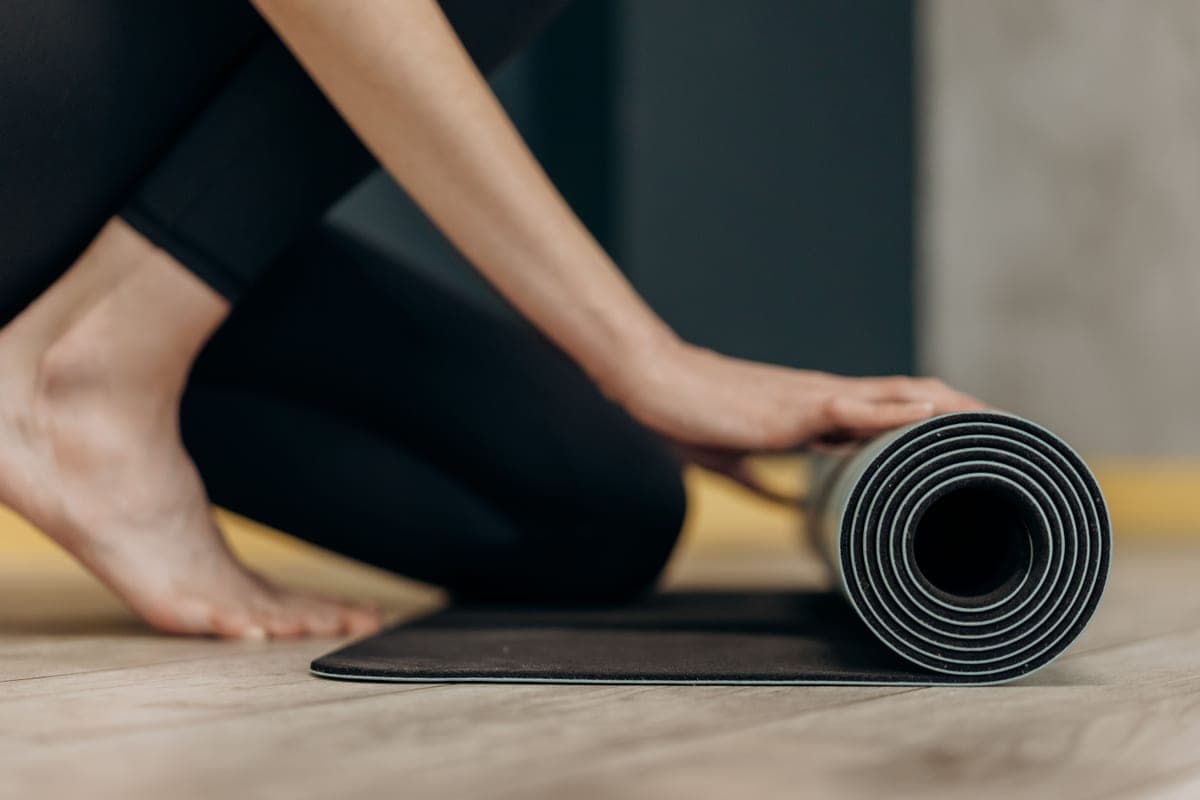
Manduka PRO 6mmDense rather than squashy: it cushions without sinking, so balancing stays possible.
Maker lists thickness: 6 mm
2 · Best targeted fix
SukhaMat Yoga Knee PadPadding exactly where you kneel and nowhere else. Keeps the rest of the mat stable.
Maker lists format: Small pad used on top of a mat
3 · Most padding for the money
Gaiam Essentials Thick Yoga MatVery soft and very cheap. You will notice it in standing poses, and for some people that is a fair trade.
Maker lists thickness: 2/5 in (about 10 mm)
4 · Budget thick mat with texture
Retrospec Solana Yoga MatMore surface grip than a plain foam mat at a similar price.
Maker lists thickness: 1/2 in (about 12.7 mm)
5 · Best grip with decent cushion
Manduka eKO 5mmFive millimeters of natural rubber. Less padding than the PRO, better grip out of the box.
Maker lists thickness: 5 mm
#ad · Prices are set by Amazon and change often, so we do not print them. Figures here are the manufacturer's own. The ranking is editorial, made against the criteria on our How We Pick page, not from lab work. Photos are stock. Tap a pick for the full write-up.
The short answer
A dense 6 mm mat plus a knee pad beats a 10 mm foam mat for almost everyone. You get real padding under the knee, where you need it, and a stable surface under your feet, where you do not want to sink.
If you would rather have one object than two, the Manduka PRO is the single-mat answer: at 6 mm it is thick, and because it is dense rather than soft it does not wobble the way a foam mat of the same thickness would.
Thicker is not the same as kinder
The intuition is that more foam means less pressure on the knee. That is true up to a point and then it stops being true, because very soft foam bottoms out — your kneecap compresses the material until it is effectively resting on the floor anyway, just with a slower arrival.
Density is what stops that happening. A dense 6 mm mat spreads the load over a wider area and keeps a layer of material between bone and floor through the whole movement. A soft 10 mm mat gives more at first and less at the point it matters.
The cost of soft thickness shows up everywhere else. Standing balances become genuinely hard on 10 mm of foam, and plank and downward dog feel unstable because your hands sink. If your practice is mostly seated and kneeling, that trade is fine. If it is a standing flow, it is not. The thickness guide sets out the whole range.
Fixing the positions that hurt
- Low lunge and kneeling poses. Fold the front edge of the mat under your knee, or use a knee pad. Free first, cheap second.
- Table top and cat-cow. Widen your knees slightly. Less pressure per square inch, no equipment.
- Hero pose and any deep kneel. Sit on a block rather than on your heels. This is a block problem more than a mat problem — see how to use blocks.
- Pigeon and hip openers. Support the hip with a folded blanket or a bolster so the knee is not taking the load at an angle.
Almost all of that is technique and props rather than mat thickness, which is worth knowing before you buy anything at all.
In detail
Every pick, in full
1
Stock photoBest overall for joints
Manduka PRO 6mm
As the manufacturer lists it · Manduka
What it gets right
- Dense enough that kneeling and forearm work stop hurting
- Closed cell, so sweat sits on top instead of soaking in
- Genuinely lasts — the lifetime guarantee is the maker's own
- An 85 in version exists if you are tall
What it does not
- Heavy. This is not a mat you carry far
- Slippery out of the box until the surface is broken in
- Closed-cell grip drops away once your hands are wet
Skip it if
you want grip on day one, practice hot, or need to carry the mat anywhere.
#ad · Price set by Amazon · Affiliate disclosure for the link to Manduka PRO 6mm
2
Stock photoBest targeted fix
SukhaMat Yoga Knee Pad
As the manufacturer lists it
What it gets right
- Targets the padding where you actually need it
- Leaves the rest of the mat firm for balancing
- Small enough to keep in a bag
What it does not
- One more thing to move around mid-practice
- Can slide on a slick mat
- Not useful if your problem is wrist pain in plank
Skip it if
you want one surface and no extra pieces — get a 6 mm mat instead.
#ad · Price set by Amazon · Affiliate disclosure for the link to SukhaMat Yoga Knee Pad
3
Stock photoMost padding for the money
Gaiam Essentials Thick Yoga Mat
As the manufacturer lists it · Gaiam
What it gets right
- The most forgiving surface here for knees and elbows
- Long enough for most people at 72 in
- Comes with a strap, so nothing extra to buy
What it does not
- Standing balances wobble on this much foam
- Foam dents and compresses over time
- Not a grippy surface once damp
Skip it if
your practice is mostly standing poses and balances.
#ad · Price set by Amazon · Affiliate disclosure for the link to Gaiam Essentials Thick Yoga Mat
4
Stock photoBudget thick mat with texture
Retrospec Solana Yoga Mat
As the manufacturer lists it
What it gets right
- More surface texture than a plain foam mat
- Long enough at 72 in for most people
- Cheap and widely stocked
What it does not
- Foam still dents under knees over time
- Not a hot-yoga surface
- Colors vary in finish between batches, buyers report
Skip it if
you want a mat that will still be flat in three years.
#ad · Price set by Amazon · Affiliate disclosure for the link to Retrospec Solana Yoga Mat
5
Stock photoBest grip with decent cushion
Manduka eKO 5mm
As the manufacturer lists it · Manduka
What it gets right
- Grippy immediately, dry or lightly damp
- Enough cushion for most floor work
- Natural rubber rather than PVC
What it does not
- Distinct rubber smell for the first weeks
- Heavier than a PVC mat of the same thickness
- Natural rubber contains latex proteins
Skip it if
you have a latex allergy, or a strong rubber smell in a small room would put you off practicing.
#ad · Price set by Amazon · Affiliate disclosure for the link to Manduka eKO 5mm
What to look for
| If | Buy | Why |
|---|---|---|
| Only kneeling hurts | A 5-6 mm dense mat and a knee pad | Targeted padding, stable everywhere else |
| Everything on the floor hurts | A thick foam mat | More cushion throughout; accept the wobble |
| You mostly do standing flows | A 6 mm dense mat only | Stability matters more than maximum padding |
| You practice on carpet | A 4-5 mm mat | The carpet is already the padding |
One thing this page cannot do is tell you why your knees hurt. Padding makes kneeling more comfortable; it does not treat anything. If the pain is sharp, one-sided or getting worse, that is a conversation with a clinician rather than a shopping decision.
How we picked
Chosen on published criteria, and we say so
Most gear sites open by telling you how many hours they spent with the products. We have not used most of these, and we would rather say so than imply otherwise. Every pick here is chosen against criteria we publish — grip, cushioning, size options, what buyers report after a year of use, and whether the thing is still actually sold — and every manufacturer figure on the page is labeled as the maker's claim.
Nobody pays for a place on this page, no product was supplied free in exchange for coverage, and a specification the maker does not publish is never guessed at. See the full criteria and weighting.
FAQ
Questions people ask
How thick should a yoga mat be for bad knees?
Is a knee pad better than a thick mat?
Can I just fold my mat under my knee?
Related
Keep reading
Update log
What changed
- First published.
Receipts
Sources
- 1.OutdoorGearLab — The Best Yoga Mats
- 2.Healthline — The Best Workout Mats
- 3.Manduka — product information
- 4.NCCIH (US National Institutes of Health) — Yoga: What You Need To Know
We have not used every product on this page, and we do not pretend otherwise. Thicknesses, materials, sizes and warranty terms are the manufacturer's published figures, shown as their claims. Anything about materials, skin or injury is linked to a source. Prices are set by Amazon and change constantly, so we never print one. Read the full method.