Pilates at Home Best picks
The Best Resistance Bands for Pilates
A flat band is the cheapest thing in this category and the one most pilates instructors actually ask for. It is also the one most people buy wrong, because the gym aisle sells tubes with handles.
We earn a commission when you buy through links on this page, at no extra cost to you. It never decides a ranking: the method is published. How we are funded
Quick picks
The short answer
1 · Best for mat pilates
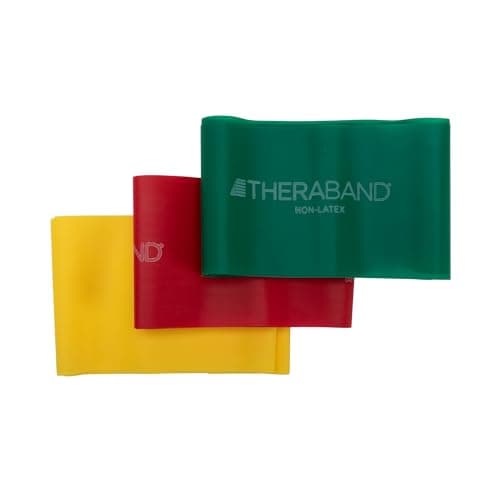
THERABAND Non-Latex Bands, Beginner SetThe flat, wide, latex-free band in the three lightest grades. If a class or a video says band, this is the object it means.
Maker lists bands: Three: yellow, red, green
2 · Best graded set
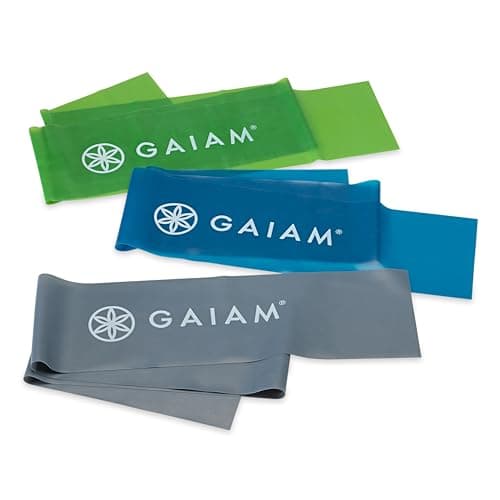
Gaiam Restore Strength and Flexibility Band KitThe same flat format with the resistance printed in pounds instead of colors, so the step between bands is legible before you pull on it.
Maker lists bands: Three: light, medium, heavy
3 · Best for leg series
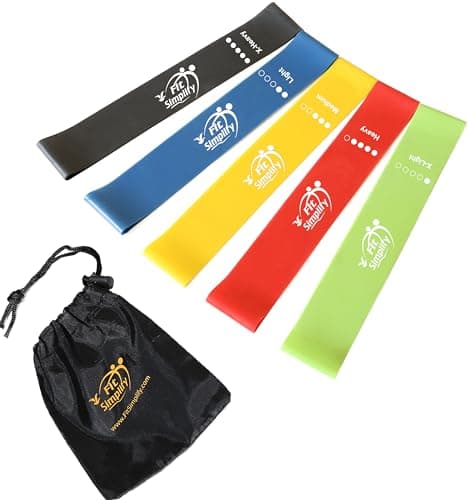
Fit Simplify Resistance Loop Bands, Set of 5Five small closed loops. A different tool, not a cheaper one: a loop stays above the knees through a whole side-lying sequence where a flat band slides off.
Maker lists bands: Five closed loops
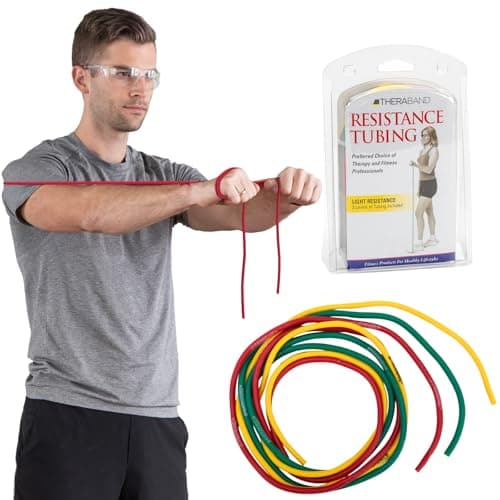
4 · Best for pulling work
THERABAND Resistance Tubes SetRound cord instead of flat band, in the same three grades. Easier to hold and the nearest thing here to the feel of a reformer strap.
Maker lists format: Round tubing
#ad · Prices come live from Amazon, last checked November 3, 2026. Figures here are the manufacturer's own. The ranking is editorial, made against the criteria on our How We Pick page, not from lab work. Photos come from Amazon. Tap a pick for the full write-up.
The short answer
Buy a set of flat therapy bands in the three lightest grades. Not a tube with handles, not a single mini loop, not a door-mounted kit. Pilates uses a wide flat band because the band has to sit across the sole of a foot, around the arch, or over a thigh without digging a groove into you, and a round cord does exactly that.
This is the one purchase in home pilates where the cheap option is also the correct option. A flat band set costs less than a pair of grip socks and it unlocks most of the resistance work a studio class does without a machine: the footwork, the arm series lying down, the single-leg stretch with the band around one foot, the side-lying leg work. It is also the sensible thing to own before a bar, before a ring and a very long way before a reformer — the order we argue for in what you actually need for pilates at home.
What actually decides it
Four things separate these, and the first one is not a matter of degree — it changes what exercises you can do at all:
- Format. Flat open band, small closed loop, or round tube. These are three different tools. The flat band is the pilates default; a loop is for the lower body; a tube is for pulling.
- Resistance grade, and how many you get. One band is one load. Pilates progresses by changing the band rather than by adding reps, so a set of three or five matters more than the exact tension of any one of them.
- Length. A flat band around 5 feet reaches around both feet with your hands at your chest. A 60-inch band is slightly short for that and better seated. A 12-inch loop reaches nothing — it is worn, not held.
- Latex or not. A real constraint rather than a preference, and the sets differ. Covered properly below.
What does not matter: handles, door anchors, ankle straps and the printed exercise card. Handles in particular are a gym feature — in pilates your hands hold the band itself, because gripping it short or long is how you change the leverage mid-exercise.
Flat band, loop or tube
| Flat band | Closed loop | Round tube | |
|---|---|---|---|
| Around the soles of both feet | Yes, comfortably | No | Digs in |
| Above the knees, side-lying | Slides off | Stays put | No |
| Arm work lying down | Yes | No | Yes |
| Looped to a fixed point | Awkward | No | Yes |
| Packs into a pocket | Rolls up | Yes | Coils |
| Grip comfort | Wide, needs a wrap | Not held | Easiest to hold |
Read the first two rows together, because they are the reason this page has four picks instead of one. The flat band owns footwork and arm work; the closed loop owns the side-lying leg series, clamshells and bridges. Neither does the other job. If you only do mat classes from a video, the flat band covers most of what you will be asked for. If the classes you follow are heavy on glute and outer-hip work, you want both, and together they still cost less than almost anything else on this site.
The tube is the specialist. Its advantage is that a cord is easy to hold and easy to anchor, which makes it the closest cheap approximation of a reformer strap in your hands. Its disadvantage is the same thing: a narrow cord against a bare foot concentrates pressure where a flat band spreads it. Buy the tube third, or not at all.
Which resistance to buy
Lighter than you think. This is the mistake that makes people abandon bands: pilates band work is slow, controlled and often done with the limb at a long lever, so a band that feels trivially light held in two hands is substantial with your leg extended at the end of its range. Instructors reach for the lightest or second-lightest grade for most mat work, not the heaviest.
The flat-band world is color-coded, and the order runs from the lightest tan and yellow through red and green to blue, black and beyond. The beginner sets sold for pilates are the yellow-red-green end of that range on purpose. If you already strength train, start at red rather than yellow; if you are new to resistance of any kind or working around a joint, start at yellow.
The practical reason to buy a set rather than a single band is that progression in pilates happens by swapping, not by straining. The same footwork sequence is a beginner exercise with a yellow band and an advanced one with a green, and nothing about your form has to change in between. One band means you outgrow the exercise; three means you keep it.
A note on the pound ratings some sets print. They are measured at a stated amount of stretch, and different makers state different amounts, so a 20-pound band from one brand is not a 20-pound band from another. The numbers are useful for comparing bands inside one set and close to meaningless across brands. The color-coded clinical system is more consistent, which is why therapy-grade bands are the ones most instructions assume.
The latex question
Most resistance bands are natural latex, and a latex allergy is common enough that it is worth checking before you order rather than after. The sets here differ: the flat beginner set we rank first is latex-free, the loop set is explicitly 100% natural latex, and the tube set is latex. A latex-free band behaves very slightly differently — a little less snap at the end of the range — and for pilates work that difference is not something you would notice.
Two related points that apply to any band whatever it is made of. First, bands degrade: they go tacky, then they nick at an edge, then they fail, and a band that fails under tension does so with some speed. Check the edges before each use and retire anything with a nick. Second, store them out of sunlight and away from heat, because both shorten the life of latex considerably. A band kept in a drawer lasts years; one left on a sunny windowsill lasts a season.
What a band cannot do
Worth being straight about, because bands get sold as a reformer substitute and they are not one. A band and a reformer spring both resist you, and they do it with opposite shapes. A band gets harder the further you stretch it, so the resistance is lightest exactly where a pilates exercise wants control — at the start of the movement — and heaviest at the end. A spring loads up early and stays comparatively even, which is why reformer footwork feels supported rather than snatchy.
The practical consequence is that a band is excellent for adding load to mat work and poor at imitating a carriage. If what you want is the reformer feeling, a band is not the cheap version of it — the alternatives page sets out what actually gets you closer, and bar versus bands is the specific comparison if you are deciding between loose bands and a bar that frames them.
The other thing a band cannot do is replace a mat. Band work is done lying down, and the bits of you that hurt doing it are your spine against the floor and the back of your head — which is a cushioning problem, not a resistance one. If you are assembling the kit from nothing, a firm mat for pilates comes first and the band comes second.
In detail
Every pick, in full
1
Best for mat pilates
THERABAND Non-Latex Bands, Beginner Set
As the manufacturer lists it · THERABAND
What it gets right
- Flat and wide, so it sits across a foot or a thigh without digging in
- Three grades means you can keep the same exercise and change the load
- Latex-free, which makes it usable by anyone with a latex sensitivity
- The color order is the one clinics use, so instructions elsewhere translate
What it does not
- The lightest grade will feel like nothing if you already strength train
- Flat bands have no handles, so you grip the band itself
- A flat band needs replacing once it goes tacky or nicks at an edge
Skip it if
you want the band for glute and hip work — a closed loop stays put where a flat band slides.
#ad · Price as of November 3, 2026 · Affiliate disclosure for the link to THERABAND Non-Latex Bands, Beginner Set
2
Best graded set
Gaiam Restore Strength and Flexibility Band Kit
As the manufacturer lists it · Gaiam
What it gets right
- Resistance is given as a number, so the step between bands is legible
- Shorter than a therapy band, which is easier to manage seated
- Stocked in general sporting goods stores, so returns are straightforward
What it does not
- Contains latex, so it is out for anyone with a latex allergy
- The heavy band is a big jump for pilates arm work
- Shorter length limits the exercises that loop around both feet
Skip it if
you need a latex-free band, or you want the wider therapy-grade band for footwork.
#ad · Price as of November 3, 2026 · Affiliate disclosure for the link to Gaiam Restore Strength and Flexibility Band Kit
3
Best for leg series
Fit Simplify Resistance Loop Bands, Set of 5
As the manufacturer lists it · Fit Simplify
What it gets right
- A closed loop stays above the knees through a whole side-lying series
- Five grades, so the jump between levels is small
- Packs into a pocket, which a 5 ft flat band does not
- The least expensive useful thing in this entire category
What it does not
- Natural latex, so not an option with a latex allergy
- Narrow loops can roll and pinch on bare thighs
- No use at all for the arm and footwork a flat band is for
Skip it if
the pilates you do is mostly arms, shoulders and footwork — loops do not reach.
#ad · Price as of November 3, 2026 · Affiliate disclosure for the link to Fit Simplify Resistance Loop Bands, Set of 5
4
Best for pulling work
THERABAND Resistance Tubes Set
As the manufacturer lists it · THERABAND
What it gets right
- A cord is easier to hold onto than a wide flat band
- Loops around a door anchor or a table leg without twisting flat
- Same color grading as the flat bands, so the grades line up
What it does not
- A thin cord concentrates pressure, so it is uncomfortable against a bare foot
- This set is latex, unlike the flat beginner set
- No handles included, so you are gripping the tube
Skip it if
you want the band to sit across the sole of your foot — that is a flat band's job.
#ad · Price as of November 3, 2026 · Affiliate disclosure for the link to THERABAND Resistance Tubes Set
What to look for
- Flat and at least 4 inches wide, if you want one band for general pilates. Narrow bands roll into a cord under tension and then they dig in.
- Three grades minimum. One band is one exercise difficulty. The set is the point.
- About 5 feet long for a flat band. Enough to loop both feet with your hands at your chest. Shorter bands are fine seated and frustrating lying down.
- Check the latex content against your own skin, not against the price. Latex-free sets exist in the same formats and grades.
- Skip the handles, the door anchor and the ankle cuffs. Those are gym-cable features. In pilates you shorten and lengthen your grip on the band itself, which a handle prevents.
- Buy loops separately if you need them, rather than hoping a flat band will stay above your knees. It will not.
One honest caveat on the loop sets. They are the cheapest thing here and they are also the item most likely to sit unused, because the side-lying leg series is the part of a pilates class people skip at home. If you are not sure whether you will do that work, buy the flat band set first and add loops when a video asks for them twice.
And if your reason for wanting a band is that mat work has stopped being hard, a band is one of three answers and not automatically the best one. A ring loads the inner thighs and the arms in a way a band does not, and it needs no setup at all — the ring picks cover it, and ring versus ball works through the small-props decision properly.
How we picked
Chosen on published criteria, and we say so
Most gear sites open by telling you how many hours they spent with the products. We have not used most of these, and we would rather say so than imply otherwise. Every pick here is chosen against criteria we publish — grip, cushioning, size options, what buyers report after a year of use, and whether the thing is still actually sold — and every manufacturer figure on the page is labeled as the maker's claim.
Nobody pays for a place on this page, no product was supplied free in exchange for coverage, and a specification the maker does not publish is never guessed at. See the full criteria and weighting.
FAQ
Questions people ask
What kind of resistance band does pilates use?
Which resistance level should I start with?
Are loop bands and flat bands interchangeable?
Can a resistance band replace a pilates reformer?
How long does a resistance band last?
Are there latex-free pilates bands?
Related
Keep reading
Update log
What changed
- First published.
Receipts
Sources
- 1.WellBefore — THERABAND latex-free bands: published 5 ft by 4 in dimensions and the yellow-red-green order
- 2.Academy Sports — Gaiam Restore Strength and Flexibility Kit (three bands, 60 in, stated pound ratings)
- 3.Fit Simplify — Resistance Loop Bands set of 5 (published 12 by 2 in size, five levels, latex content)
- 4.THERABAND — exercise balls and product specifications
- 5.Merrithew — Pilates equipment shop
We have not used every product on this page, and we do not pretend otherwise. Thicknesses, materials, sizes and warranty terms are the manufacturer's published figures, shown as their claims. Anything about materials, skin or injury is linked to a source. Prices are set by Amazon and change constantly, so we never type one into the text — every figure comes from Amazon's own data, dated, and disappears rather than going stale. Read the full method.