Pilates at Home Comparison
Pilates Bar vs Resistance Bands: Which Do You Need?
Every pilates bar is a set of resistance bands with a stick in the middle. That stick is either the thing that makes the bands usable or an unnecessary object, depending on what you practice.
We earn a commission when you buy through links on this page, at no extra cost to you. It never decides a ranking: the method is published. How we are funded
Side by side
The two, next to each other
Buy for reformer-style leg work
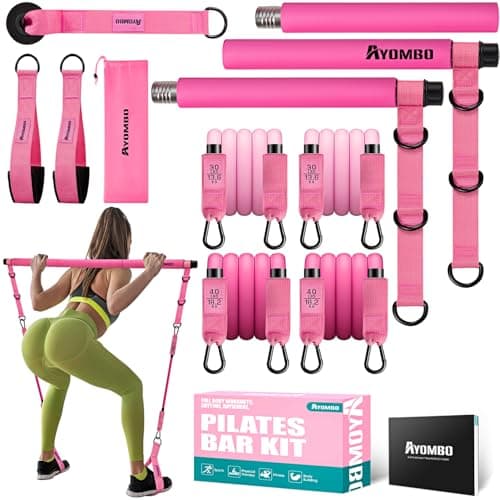
Ayombo 3-Section Pilates Bar Kit
A three-section bar that breaks down for storage, with bands and foot straps. The closest a bar gets to a footbar feel.
$24.66Amazon#ad · Price as of November 3, 2026 · Affiliate disclosure for the link to Ayombo 3-Section Pilates Bar Kit
Buy if sturdiness is the worry
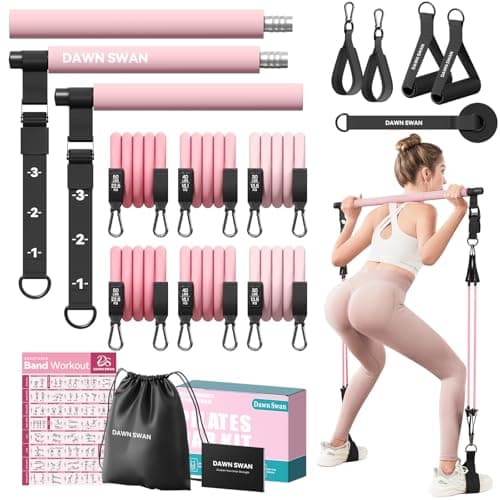
DAWN SWAN Pilates Bar Kit
A heavier build than the budget bars, which is the main complaint people have about this category.
$25.90Amazon#ad · Price as of November 3, 2026 · Affiliate disclosure for the link to DAWN SWAN Pilates Bar Kit
Buy if bands are all you want
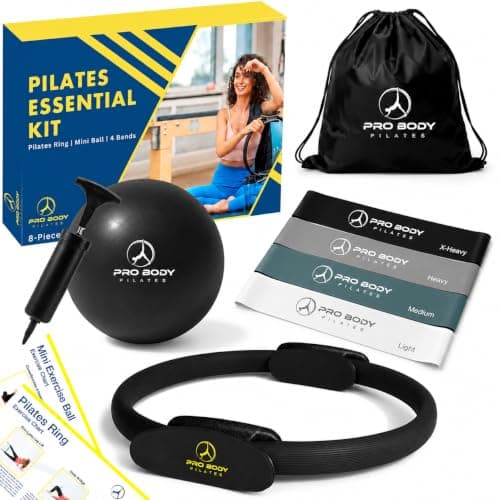
ProBody Pilates Ring, Ball and Band Kit
Ring, ball and band together. If the bar is not the point, this covers the resistance work for less and stores in nothing.
$28.95Amazon#ad · Price as of November 3, 2026 · Affiliate disclosure for the link to ProBody Pilates Ring, Ball and Band Kit
The verdict
Buy a pilates bar if you want reformer-style leg and footwork at home. The bar gives the bands a fixed point, keeps both legs working symmetrically, and lets you push rather than only pull. That is the part of reformer work that loose bands genuinely cannot reproduce.
Buy loose resistance bands if you want upper-body and glute work, or if space and money are tight. Bands do more exercises than a bar, cost far less, pack into a pocket, and are the more useful object if you travel or train anywhere other than one room.
Side by side
| Pilates bar kit | Resistance bands | |
|---|---|---|
| What it is | A bar, bands, handles and foot straps | Loops or tubes with handles |
| Push exercises | Yes, the bar gives you something to push | Awkward; bands pull well and push badly |
| Symmetry between limbs | Enforced by the bar | Up to you to maintain |
| Exercise range | Narrower, reformer-style | Wider, including upper body and glutes |
| Storage | Breaks into sections; still a bar | Pocket-sized |
| Relative cost | Several times a band set | The cheapest resistance there is |
| Travels | Poorly | Perfectly |
| Main failure point | Bar flex and band clips | Bands perishing or snapping |
The honest summary of that table: the bar buys you one specific movement pattern, and bands buy you breadth. Which is better depends entirely on whether that movement pattern is what you came for.
What the bar actually adds
A fixed point you can push against. On a reformer, your feet press the footbar and the carriage moves. A bar with bands anchored under your feet reproduces a version of that: you press the bar away and the bands resist. With loose bands there is nothing rigid to press, so footwork turns into a pull, which is a different exercise.
Symmetry. Because both bands attach to one bar, both sides get the same load and travel the same distance. With two loose bands it is easy for the stronger side to do more work without you noticing, which is the opposite of what pilates is for.
A longer lever. The bar lets you work at arm's length with a stable grip, which makes some chest and overhead exercises cleaner than they are with handles alone.
What a bar does not add is the thing people hope for most. It is not a reformer: there is no carriage, no moving platform, and the resistance curve of a band is nothing like a spring. The bands get harder the further you stretch them; a spring is far more linear. That gap is the subject of bar versus reformer.
Build quality is the real variable in this category. Cheap bars flex under load and cheap clips let go, and both are worse than they sound when the band is stretched. The ranked options are in the bar roundup.
Where loose bands win
Breadth of exercise. Bands do rows, presses, pull-aparts, lateral walks, glute bridges, clamshells, bicep and tricep work, and most of the upper-body repertoire. A bar does a narrower set.
Cost. A band set is a fraction of a bar kit, and if you are not sure resistance work suits your practice, that is the correct amount to risk — the band sets we pick cover the flat therapy band mat classes mean and the closed loops the leg series needs.
Space and travel. Bands weigh nothing and go in a suitcase. A three-section bar is better than a one-piece bar and is still a bar. In a small flat this is not a minor point — space is usually the binding constraint.
Progression. Buying a slightly heavier band is cheap. Changing the resistance on a bar kit means whatever bands came in the box, and swapping them is fiddlier.
For most people starting mat pilates at home, a ring, a mini ball and a band do more than a bar does, and the ordered list of what to buy is in what you actually need. A bar is a later purchase, bought for a reason.
In detail
Both, in full
Buy for reformer-style leg work
Ayombo 3-Section Pilates Bar Kit
As the manufacturer lists it
What it gets right
- Packs into a drawer
- Band strengths cover beginner to reasonably strong
- Costs less than a month of studio classes
What it does not
- Screw-together joints work loose and need checking
- Band resistance rises through the range, unlike springs
- Footstraps are the first thing to wear
Skip it if
you want the carriage movement of a reformer — a bar cannot give you that.
#ad · Price as of November 3, 2026 · Affiliate disclosure for the link to Ayombo 3-Section Pilates Bar Kit
Buy if sturdiness is the worry
DAWN SWAN Pilates Bar Kit
As the manufacturer lists it
What it gets right
- Bar feels less flexy than the cheapest kits
- Handles are more comfortable for longer sets
- Comes with a storage bag
What it does not
- Still a bar and bands, with a bar's limits
- Bands need replacing after heavy use
- Heavier to hold overhead than a light bar
Skip it if
you want the lightest possible kit to travel with.
#ad · Price as of November 3, 2026 · Affiliate disclosure for the link to DAWN SWAN Pilates Bar Kit
Buy if bands are all you want
ProBody Pilates Ring, Ball and Band Kit
As the manufacturer lists it
What it gets right
- Covers nearly every prop a beginner mat class calls for
- Cheaper than buying the pieces separately
- Everything fits in the supplied bag
What it does not
- Individual pieces are budget-grade
- Bands are the first thing you will replace
- You may only ever use two of the four items
Skip it if
you already own bands and only want a ring.
#ad · Price as of November 3, 2026 · Affiliate disclosure for the link to ProBody Pilates Ring, Ball and Band Kit
If you want the reformer feel
Plenty of people buying a bar are really trying to get reformer work into a living room. The bar is the cheapest attempt at that and the furthest from it. Two closer options exist, both covered elsewhere on the site.
A reformer board gives you a sliding carriage and spring or band resistance on something roughly the footprint of a mat. It is a real step closer to the movement pattern, stores against a wall, and costs a fraction of a machine — boards are ranked here, and bar versus board is the direct comparison.
A folding reformer is the real thing with a hinge in the middle. It needs genuine floor space even folded, and it is the only option on this page that actually reproduces a studio session — folding reformers here, with the honest cost and space arguments in is a reformer worth it.
Bands and a bar are not a cheap reformer. They are good, useful, limited tools that happen to sit in the same part of a search results page.
How we picked
Chosen on published criteria, and we say so
Most gear sites open by telling you how many hours they spent with the products. We have not used most of these, and we would rather say so than imply otherwise. Every pick here is chosen against criteria we publish — grip, cushioning, size options, what buyers report after a year of use, and whether the thing is still actually sold — and every manufacturer figure on the page is labeled as the maker's claim.
Nobody pays for a place on this page, no product was supplied free in exchange for coverage, and a specification the maker does not publish is never guessed at. See the full criteria and weighting.
FAQ
Questions people ask
Is a pilates bar better than resistance bands?
Can I do pilates with just resistance bands?
Is a pilates bar like a reformer?
What resistance band should I start with for pilates?
Related
Keep reading
Update log
What changed
- First published.
Receipts
Sources
- 1.Merrithew — Pilates equipment shop
- 2.ProBody Pilates — mini exercise balls
- 3.Balanced Body — Pilates equipment
- 4.NBC Select — The best Pilates reformers
- 5.WorkoutHealthy — Pilates reformers for home and small spaces
We have not used every product on this page, and we do not pretend otherwise. Thicknesses, materials, sizes and warranty terms are the manufacturer's published figures, shown as their claims. Anything about materials, skin or injury is linked to a source. Prices are set by Amazon and change constantly, so we never type one into the text — every figure comes from Amazon's own data, dated, and disappears rather than going stale. Read the full method.