Yoga Mats Guide
Why Does My Yoga Mat Smell?
New-mat smell and old-mat smell are two completely different problems. One needs patience and air; the other needs cleaning, and possibly a different material.
We earn a commission when you buy through links on this page, at no extra cost to you. It never decides a ranking: the method is published. How we are funded
The short answer
If the mat is new, you are smelling the material, and it goes away in one to four weeks. Natural rubber smells of rubber, PVC and TPE smell faintly chemical, and both fade as the manufacturing volatiles leave. Unroll the mat somewhere ventilated, out of direct sunlight, and use it.
If the mat is not new, you are smelling bacteria in sweat the mat absorbed, and that needs cleaning rather than waiting. Sour, musty or feet-like smells belong in this category. So does a smell that returns within a day of cleaning, which usually means the odor is inside an open-cell surface rather than on it.
New-mat smell: the material
Every mat material has a signature, and it is worth knowing which one you bought so you can tell whether the smell is expected.
Natural rubber is the strongest by a wide margin, and the most often mistaken for a defect. It smells like a tire shop for the first week or two and settles into something faint. Open-cell rubber such as the Jade Harmony holds it slightly longer than closed-cell rubber. This is not a flaw and it is not avoidable in the material — both rubber options smell at first.
PVC and TPE smell mildly plastic and clear faster, usually within a week or two. A strong chemical smell that is still strong after a month is unusual and worth returning.
Cork barely smells at all, which is one of its quiet advantages and part of why it suits anyone sensitive to this — cork versus rubber compares the two properly.
To speed it up: unroll the mat completely, leave it flat in a well-ventilated room for several days, and wipe it once with a mild soap solution. Do not put it in the sun to accelerate things — sunlight degrades rubber and PVC and you will trade a smell for a shortened lifespan.
Old-mat smell: trapped sweat
Sweat is mostly water and salt, and on its own it does not smell much. What smells is what grows in it afterwards, which is why a mat that is wiped after practice stays fine and a mat that is rolled up damp does not.
Rolling a damp mat is the single biggest cause. A rolled mat is a sealed, warm, humid tube, and an open-cell surface holds moisture well inside it. Within a few sessions you have a smell that a quick wipe will no longer touch.
The fix depends on the surface. A closed-cell mat holds odor on the top layer, so a thorough clean with a mat cleaner, then a full dry flat, resolves it. An open-cell mat has absorbed the problem, and needs a longer, gentler process: a damp cloth with mild soap, worked over the whole surface, then rinsed with a clean damp cloth, then dried flat for a day. Repeat rather than escalating to something harsher.
What not to reach for: vinegar, rubbing alcohol, bleach or an essential-oil soak. Vinegar and alcohol strip rubber and dull PVC, bleach damages everything, and oils leave a film that makes the mat slippery — which is one of the most common causes of a mat that suddenly will not hold a hand. The method that works, by material, is in the cleaning guide.
Which smell is which
| What you smell | Likely cause | What to do |
|---|---|---|
| Strong rubber or tire | New natural rubber mat | Air it flat for one to two weeks; it fades |
| Faint plastic or chemical | New PVC or TPE mat | Air it for a week; wipe once with mild soap |
| Sour or musty | Bacteria in absorbed sweat | Full clean, then dry completely flat |
| Feet | Sweat in an open-cell surface | Repeat gentle cleans; stop rolling it up damp |
| Mildew | Stored damp or rolled wet | Clean, dry fully; replace if it returns quickly |
| Perfume that went wrong | Essential oils or scented cleaner | Wash the film off with mild soap |
The picks
What to clean it with, and the low-odor alternative
Routine cleaning
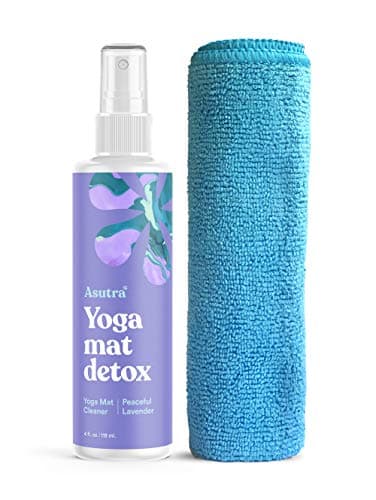
ASUTRA Natural Yoga Mat Cleaner
A plant-based spray that ships with a microfiber cloth, so it is the whole job in one purchase. Light scent, and it does not leave a film that makes the mat slicker.
$13.99Amazon#ad · Price as of November 3, 2026 · Affiliate disclosure for the link to ASUTRA Natural Yoga Mat Cleaner
- MandukaNo image
Cleaning a rubber or PVC mat safely
Manduka Mat Renew Cleaner
The maker's own cleaner, which matters mainly because Manduka voids nothing and states it is safe on their surfaces. Alcohol-free, so it will not dry out rubber.
Check price on Amazon#ad · Price as of November 3, 2026 · Affiliate disclosure for the link to Manduka Mat Renew Cleaner
- GurusNo image
A first cork mat
Gurus Roots Cork Yoga Mat
A well-reviewed cork-over-rubber mat that undercuts the specialist cork brands. It arrives with a memory of the roll and needs a week to flatten.
Check price on Amazon#ad · Price as of November 3, 2026 · Affiliate disclosure for the link to Gurus Roots Cork Yoga Mat
Keeping it from coming back
- Never roll a damp mat. This is 80 percent of the problem. Leave it unrolled until it is genuinely dry, every time.
- Wipe after sweaty sessions, deep clean monthly. Little and often beats a rescue mission.
- Use a towel in heated classes. It takes the sweat before the mat does, and it goes in the wash — see whether you need one.
- Store it unrolled or loosely rolled, in the shade. Hanging over a rail is ideal. Rolled tight in a bag is the worst case.
- If odor is a recurring problem, change material next time. Closed-cell PVC and cork resist it structurally; open-cell rubber never will, because absorbing is what it does.
And if the smell survives several proper cleans and keeps returning within a day, the mat has reached the end rather than being dirty — the other end-of-life signs are here.
For what to actually spray on it, the mat cleaner roundup sorts four sprays by the surface each maker says they suit.
How we picked
Chosen on published criteria, and we say so
Most gear sites open by telling you how many hours they spent with the products. We have not used most of these, and we would rather say so than imply otherwise. Every pick here is chosen against criteria we publish — grip, cushioning, size options, what buyers report after a year of use, and whether the thing is still actually sold — and every manufacturer figure on the page is labeled as the maker's claim.
Nobody pays for a place on this page, no product was supplied free in exchange for coverage, and a specification the maker does not publish is never guessed at. See the full criteria and weighting.
FAQ
Questions people ask
How long does a new yoga mat smell last?
Why does my yoga mat smell like rubber?
Can I use vinegar to clean a smelly yoga mat?
Why does my yoga mat smell like feet?
Can you put a yoga mat in the washing machine?
Related
Keep reading
Update log
What changed
- First published.
Receipts
Sources
- 1.Manduka — product information
- 2.JadeYoga — product information
- 3.OutdoorGearLab — The Best Yoga Mats
- 4.Healthline — The Best Workout Mats
- 5.Yoloha Yoga — cork mats
We have not used every product on this page, and we do not pretend otherwise. Thicknesses, materials, sizes and warranty terms are the manufacturer's published figures, shown as their claims. Anything about materials, skin or injury is linked to a source. Prices are set by Amazon and change constantly, so we never type one into the text — every figure comes from Amazon's own data, dated, and disappears rather than going stale. Read the full method.