Blocks, Straps & Props Guide
Are Yoga Blocks Worth It?
For most beginners, yes, and for a specific reason that has nothing to do with being flexible enough.
We earn a commission when you buy through links on this page, at no extra cost to you. It never decides a ranking: the method is published. How we are funded
The short answer
Yes, for almost every beginner, and they cost less than a single studio class. A block is not a concession to being inflexible. It changes which part of your body does the work, and in several common poses the version without a block is training a movement you did not intend to train.
What a block actually changes
Take a seated forward fold. The intended movement is a hinge at the hip joint with a long spine. If your hamstrings will not allow that yet, your body finds the range somewhere else, and the place it finds it is the lower back. You end up rounding forward, feeling a stretch, and stretching a part of you that did not need it.
Sit on the front edge of a block and the pelvis tips forward. Now the hinge happens at the hip, the spine stays long, and the hamstrings get the stretch. Same pose, same effort, completely different thing happening.
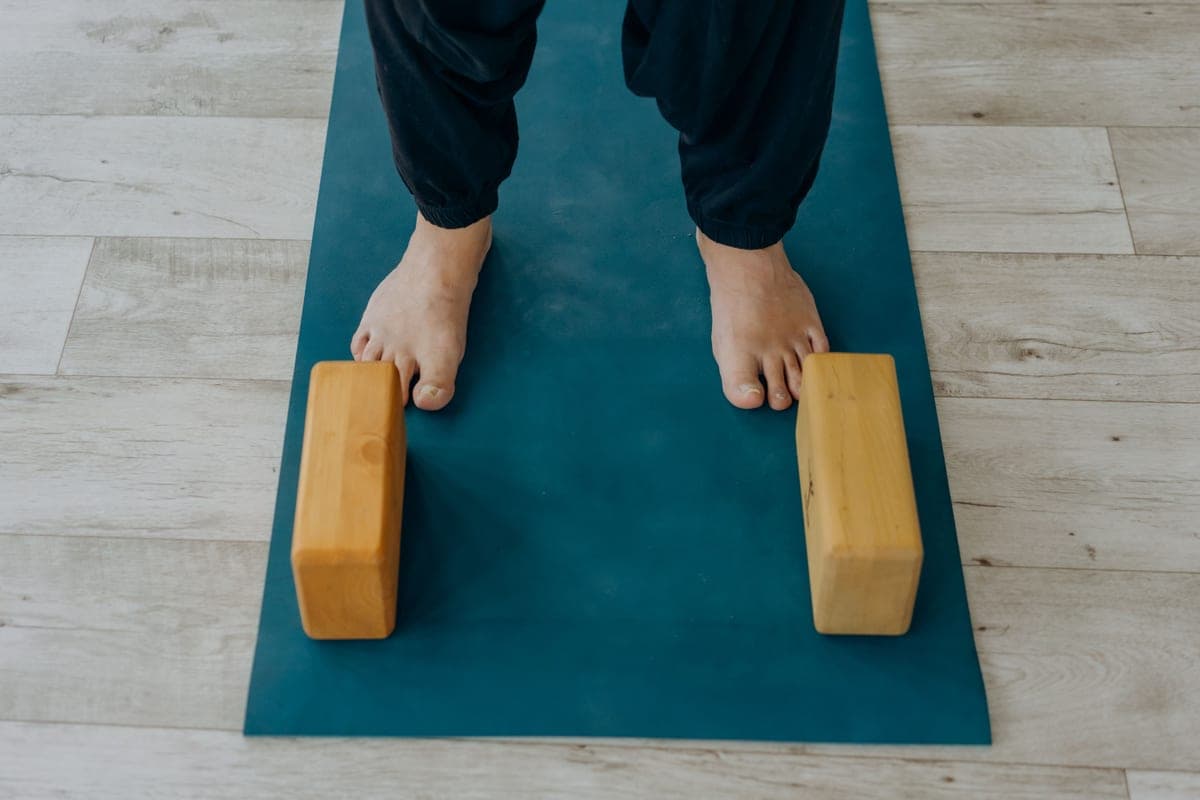
The same logic runs through most block placements. In triangle, reaching the floor collapses the top shoulder; a block under the hand keeps the chest open. In a standing fold, a block under the hands lets you keep length rather than curling. The block is not making the pose easier — it is making the pose the pose.
How to use blocks walks through eight placements where this applies.
When they are not worth it
There are genuine cases, and it would be dishonest to pretend otherwise.
- You already reach the floor comfortably with a long spine. If the hinge is happening at your hip without help, a block under your hands adds nothing. You may still want one to sit on.
- Your practice is entirely standing and balancing. Some styles use blocks rarely, and if the sequences you follow never call for one, buying a pair to have them is not a priority.
- You have something that already works. A stack of thick books, a low stool, the edge of a sofa. None is as good and all are free, and using one for a month is a perfectly reasonable way to find out whether the real thing is worth buying.
What is not a good reason to skip them: thinking you should be able to do it without. Blocks are standard equipment in studios, used by teachers, and the idea that they are remedial is the most expensive misconception in this whole category.
The picks
What to buy if the answer is yes
 Stock photo
A first block
Gaiam Yoga Essentials Foam Block
The standard foam block. Light, cheap, soft enough to rest against, and it will compress under your standing weight. For most beginners that is fine.
Check price on Amazon#ad · Price set by Amazon · Affiliate disclosure for the link to Gaiam Yoga Essentials Foam Block
- Stock photo
Two blocks, least money
REEHUT High Density Yoga Blocks (2-Pack)
Two denser-than-average foam blocks for the price of one branded one. Denser foam means less squash, which is the only thing that matters in a block this cheap.
Check price on Amazon#ad · Price set by Amazon · Affiliate disclosure for the link to REEHUT High Density Yoga Blocks (2-Pack)
- Stock photo
The whole prop kit at once
Gaiam Yoga Block & Strap Combo Set
Two foam blocks and a strap in one box, which is the exact prop kit a beginner needs and nothing more. Buying the pieces separately costs more and takes longer.
Check price on Amazon#ad · Price set by Amazon · Affiliate disclosure for the link to Gaiam Yoga Block & Strap Combo Set
A two-minute test before you spend anything
You do not have to take our word for it. Stack two or three thick books to roughly 9 inches, sit down on the floor with your legs straight out, and try a seated forward fold twice.
First, on the floor. Fold forward as far as you go and notice where the bend is happening. For most people the lower back rounds and the hip barely moves.
Then sitting on the front edge of the books. Same pose. The pelvis tips forward, the spine lengthens, and the stretch moves from your lower back into your hamstrings, which is where it was supposed to be. Most people feel the difference immediately and are slightly annoyed about it.
That is the entire argument for a block, demonstrated for free in two minutes. If you feel nothing change, you genuinely may not need one for that pose, and that is a useful answer too.
Where books fall down
They slide on a mat, they are not comfortable to grip with a flat hand, they compress unevenly, and they have one height rather than three. For sitting on, they are fine indefinitely. For anything you put weight through, they are not — which is the point at which a real block earns its very small cost.
When you do buy, the block roundup covers which one, and how to use blocks covers the seven other placements beyond the one you just tried.
How we picked
Chosen on published criteria, and we say so
Most gear sites open by telling you how many hours they spent with the products. We have not used most of these, and we would rather say so than imply otherwise. Every pick here is chosen against criteria we publish — grip, cushioning, size options, what buyers report after a year of use, and whether the thing is still actually sold — and every manufacturer figure on the page is labeled as the maker's claim.
Nobody pays for a place on this page, no product was supplied free in exchange for coverage, and a specification the maker does not publish is never guessed at. See the full criteria and weighting.
FAQ
Questions people ask
Are yoga blocks necessary?
Do experienced practitioners use blocks?
Can I use books instead of yoga blocks?
How much should I spend on yoga blocks?
Will using blocks slow down my progress?
When should I stop using a block?
Related
Keep reading
Update log
What changed
- First published.
Receipts
Sources
- 1.Yoga Journal — The Best Yoga Blocks
- 2.OutdoorGearLab — The Best Yoga Blocks
- 3.NCCIH (US National Institutes of Health) — Yoga: What You Need To Know
- 4.NBC Select — The best yoga props and apparel
We have not used every product on this page, and we do not pretend otherwise. Thicknesses, materials, sizes and warranty terms are the manufacturer's published figures, shown as their claims. Anything about materials, skin or injury is linked to a source. Prices are set by Amazon and change constantly, so we never print one. Read the full method.