Blocks, Straps & Props Guide
What Size Yoga Strap Do I Need?
Straps come in three lengths and the wrong one is useless rather than merely inconvenient. Here is how to pick without owning two of them.
We earn a commission when you buy through links on this page, at no extra cost to you. It never decides a ranking: the method is published. How we are funded
The short answer
Buy an eight-foot strap. It is the length that works for the widest range of heights and the widest range of uses, and the extra two feet over a six-foot strap cost almost nothing. If you are under about five foot six and know you only want the strap for seated hamstring work, six feet is tidier and easier to store. If you are over six foot, or you want to use the strap for shoulder work behind the back, ten feet is the length that stops being a compromise.
The mistake worth avoiding is buying six feet because it is the one in the shop. A strap that is too short for a pose does not make the pose harder, it makes it impossible, because you cannot reach the end of it in the first place.
Length by height
Strap length scales with arm span and leg length rather than height exactly, but height is a good enough proxy and it is the number you already know.
Under about five foot four. Six feet is comfortable and will not leave a long tail trailing across the mat. Eight feet still works and the surplus is simply folded.
Five foot four to six foot. Eight feet. This is the bulk of the market and the reason eight feet is the most commonly sold length.
Over six foot. Eight feet works for leg poses and runs short for anything that loops behind the back with both hands. Ten feet if you have a choice.
If you are between two lengths, go longer. Surplus strap is a minor annoyance; a short strap is a prop you stop using.
The three lengths
| Length | Suits | Good for | Runs short for |
|---|---|---|---|
| 6 ft | Up to about 5 ft 4 in | Seated forward folds, hamstring work | Shoulder openers, bound poses |
| 8 ft | Most adults | Nearly everything, including shoulders | Two-handed work if you are very tall |
| 10 ft | Over 6 ft, or shoulder-focused use | Behind-the-back work, bound poses, propping | Nothing — it just needs folding |
Width is the other published number and it matters less than people expect. Most straps are around one and a half inches wide, which is wide enough not to dig into a hand or a foot arch. Narrower webbing is harsher under tension and is usually a sign of a cheaper weave.
Length by what you use it for
If you know why you are buying the strap, that is a better guide than your height.
Hamstrings, seated and supine. The most common use by far: loop the strap around a foot and hold both ends. Six feet is enough for most people here, which is why short straps feel adequate right up until you try something else.
Shoulders and chest. Holding the strap wide behind the back, or walking the hands closer over weeks, eats length quickly. This is where six feet runs out first and where eight feet earns its keep.
Bound poses and binds you cannot reach yet. A strap stands in for clasped hands, and it needs enough length to cross the body twice. Eight feet minimum, ten if you are tall.
Holding a pose rather than deepening it. Looping the strap to make a fixed circle — around the feet in a reclined bound angle, say — needs length plus a buckle that holds under load. See the buckle section below, because this is the one use where the hardware decides whether the strap works.
Carrying a mat. A strap will do it, badly. Any length works and none of them works well, because webbing without a cinch slips. A proper sling is the better answer, and it is covered in the strap roundup.
Buckles and loops
There are three hardware styles and they are not interchangeable.
D-ring. Two metal rings. Infinitely adjustable, holds well under steady tension, and genuinely fiddly to thread the first few times. This is the default and the right default.
Cinch or plastic buckle. Faster to adjust and more likely to creep under load. Fine for propping, less good for anything where the loop has to stay exactly where you set it.
Multi-loop stretch strap. A webbing ladder of sewn loops rather than a single band. Not adjustable at all, and excellent for progressive stretching because you simply move a hand or a foot one loop further. A different tool rather than a worse one, and the better buy if physiotherapy-style stretching is what you actually have in mind.
Cotton versus nylon barely matters. Cotton has a softer hand and more grip on skin; nylon is slicker and dries faster. Both are strong enough that the webbing is never the failure point.
The picks
One strap per answer
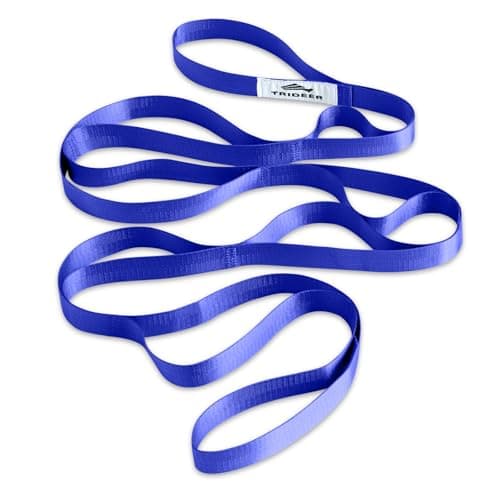
A first strap
Trideer Yoga Strap
A cotton strap with a metal D-ring buckle, sold in three lengths. There is very little to get wrong here, and this one does not slip.
$6.39Amazon#ad · Price as of November 3, 2026 · Affiliate disclosure for the link to Trideer Yoga Strap
- TumazNo image
Measured stretching
Tumaz Stretch Strap with Loops
A row of sewn loops instead of a buckle, so you move one loop at a time and can feel the progress. Better for stretching, worse for binding poses.
Check price on Amazon#ad · Price as of November 3, 2026 · Affiliate disclosure for the link to Tumaz Stretch Strap with Loops
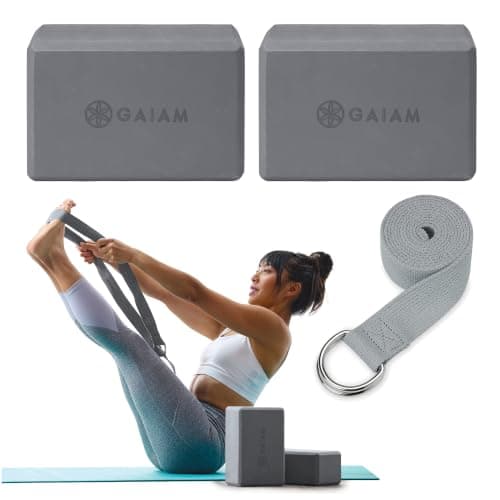
The whole prop kit at once
Gaiam Yoga Block & Strap Combo Set
Two foam blocks and a strap in one box, which is the exact prop kit a beginner needs and nothing more. Buying the pieces separately costs more and takes longer.
$19.99Amazon#ad · Price as of November 3, 2026 · Affiliate disclosure for the link to Gaiam Yoga Block & Strap Combo Set
Before you order
- Default to eight feet. If you take one thing from this page, take that. It is the length that is never useless.
- Check the width. Around one and a half inches. Narrower webbing cuts into the arch of a foot under load.
- Choose D-ring unless you have a reason not to. It is the only hardware that reliably holds a fixed loop.
- Do not buy a strap to carry your mat. It is the one job plain webbing does poorly.
- Buy the strap with blocks if you do not own blocks. The combination covers far more poses than either alone, and a bundle is usually the cheaper route — the set guide covers which bundles are worth it.
Once it arrives, the uses are worth reading — a strap is the prop people own longest and understand least.
How we picked
Chosen on published criteria, and we say so
Most gear sites open by telling you how many hours they spent with the products. We have not used most of these, and we would rather say so than imply otherwise. Every pick here is chosen against criteria we publish — grip, cushioning, size options, what buyers report after a year of use, and whether the thing is still actually sold — and every manufacturer figure on the page is labeled as the maker's claim.
Nobody pays for a place on this page, no product was supplied free in exchange for coverage, and a specification the maker does not publish is never guessed at. See the full criteria and weighting.
FAQ
Questions people ask
What size yoga strap do I need?
Is a 6 foot or 8 foot yoga strap better?
How long should a yoga strap be for a tall person?
Do I need a D-ring or a buckle on a yoga strap?
Can I use a belt instead of a yoga strap?
Related
Keep reading
Update log
What changed
- First published.
Receipts
Sources
- 1.OutdoorGearLab — The Best Yoga Blocks
- 2.Hugger Mugger — product information
- 3.Gaiam — product information
- 4.NBC Select — The best yoga props and apparel
- 5.Yoga Journal — The Best Yoga Blocks
We have not used every product on this page, and we do not pretend otherwise. Thicknesses, materials, sizes and warranty terms are the manufacturer's published figures, shown as their claims. Anything about materials, skin or injury is linked to a source. Prices are set by Amazon and change constantly, so we never type one into the text — every figure comes from Amazon's own data, dated, and disappears rather than going stale. Read the full method.