Blocks, Straps & Props Guide
How to Use a Yoga Strap
A strap is the cheapest prop and the least understood. It is not a stretching aid so much as a way to borrow the reach you do not have yet.
We earn a commission when you buy through links on this page, at no extra cost to you. It never decides a ranking: the method is published. How we are funded
The short answer
A yoga strap extends your arms. Anywhere a pose asks you to hold a foot, a shin or your own hands and you cannot reach, the strap closes the gap without you rounding your spine to get there. That is the whole principle, and it is why a strap is more useful to a stiff beginner than to a flexible one.
The second thing it does, which far fewer people use it for, is hold a shape. A strap looped into a fixed circle keeps your feet, knees or elbows a set distance apart so you can stop gripping and actually rest in a pose. That is the use that justifies a D-ring over a plastic buckle.
Setting the loop
Most of the strap's uses need a loop rather than a straight band, and a loop that slips under load is worse than no strap at all.
With a D-ring strap: pass the free end up through both rings, fold it back over the top ring, and thread it down through the lower ring only. Pull it tight. The webbing now pinches against itself and holds. If your loop is creeping, you almost certainly threaded both rings on the way back instead of one.
Set the loop size with the prop in place rather than guessing. Put your feet where you want them, then pull the strap to length. Adjusting it in the air and hoping is how people end up with a loop that is two inches too generous to do anything.
Seven things to do with it
1. Supine hamstring stretch. Lie on your back, loop one foot, hold both ends and raise the leg. The strap means your shoulders stay on the floor instead of lifting to chase the foot. This is the single most useful thing a strap does and the reason most people buy one.
2. Seated forward fold. Loop the strap around both feet and hold the ends. Instead of rounding the back to grab the toes, you keep a long spine and hinge from the hip. The fold looks smaller and does considerably more.
3. Shoulder opener, overhead. Hold the strap wide in both hands, raise it overhead and take it back behind you. Start much wider than feels necessary and bring the hands in over weeks. This is the use that eats strap length, and the reason eight feet is the sensible default.
4. Reverse prayer substitute. Hold the strap behind your back, one hand high and one low, and walk the hands toward each other. It is the cow-face arm position without forcing a clasp that is not available yet.
5. Holding a reclined bound angle. Make a large loop, pass it around your lower back and over both feet, lie back. The strap holds the shape so your hip muscles can let go. This is the clearest example of a strap as a resting aid rather than a stretching one, and it pairs naturally with a bolster under the spine.
6. Keeping legs parallel. A loop around the thighs in bridge, or around the ankles in shoulder stand prep, stops the legs splaying so you can feel the work where it belongs. Props that hold a position teach faster than cues do.
7. Dancer, pigeon and anything that catches a back foot. Loop the strap around the raised foot and walk the hands down it. You get the shape of the pose and the shoulder rotation long before the flexibility to grab the foot arrives.
What a strap does not do: build strength, replace a block, or carry a mat properly. For the first, blocks and body weight do more; for the last, a cinch sling exists for a reason.
Which use needs which length
| Use | Loop or straight | Shortest length that works |
|---|---|---|
| Supine hamstring stretch | Loop | 6 ft |
| Seated forward fold | Loop | 6 ft |
| Overhead shoulder opener | Straight | 8 ft |
| Behind-the-back hand walk | Straight | 8 ft, 10 ft if tall |
| Reclined bound angle hold | Loop | 8 ft |
| Thigh or ankle loop | Loop | 6 ft |
| Catching a back foot | Loop | 8 ft |
The picks
The two straps these uses need
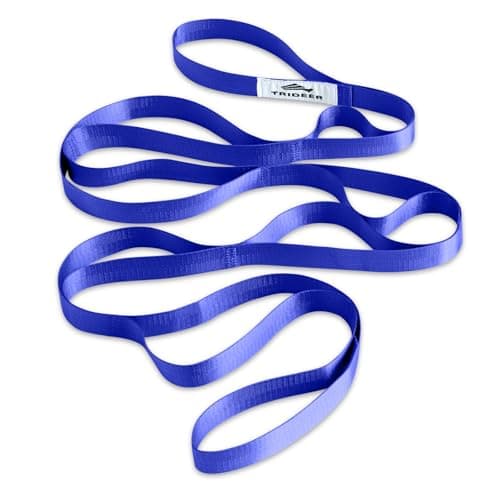
A first strap
Trideer Yoga Strap
A cotton strap with a metal D-ring buckle, sold in three lengths. There is very little to get wrong here, and this one does not slip.
$6.39Amazon#ad · Price as of November 3, 2026 · Affiliate disclosure for the link to Trideer Yoga Strap
- TumazNo image
Measured stretching
Tumaz Stretch Strap with Loops
A row of sewn loops instead of a buckle, so you move one loop at a time and can feel the progress. Better for stretching, worse for binding poses.
Check price on Amazon#ad · Price as of November 3, 2026 · Affiliate disclosure for the link to Tumaz Stretch Strap with Loops
Two mistakes
- Pulling with the arms instead of hinging. The strap is there so your spine can stay long, not so you can haul yourself deeper. If your chest has collapsed toward your knee, lengthen the strap and sit up.
- Treating the strap as a progress meter. Hand position on a strap varies with time of day, temperature and how recently you moved. Chasing a mark on the webbing invites forcing, which is the one thing a prop is supposed to prevent.
- Bonus: a loop that slips. If the D-rings creep under tension, rethread them as described above. Nearly every "my strap does not hold" complaint is a threading error rather than a faulty buckle.
If you do not own a strap yet, the lengths and buckle styles are covered in the sizing guide, and the straps themselves are ranked in the roundup.
If the reason you picked up a strap is a rounded upper back from sitting all day, four of these uses matter far more than the rest, and there is a routine built around them — the strap for posture has the sequence and the hold times.
How we picked
Chosen on published criteria, and we say so
Most gear sites open by telling you how many hours they spent with the products. We have not used most of these, and we would rather say so than imply otherwise. Every pick here is chosen against criteria we publish — grip, cushioning, size options, what buyers report after a year of use, and whether the thing is still actually sold — and every manufacturer figure on the page is labeled as the maker's claim.
Nobody pays for a place on this page, no product was supplied free in exchange for coverage, and a specification the maker does not publish is never guessed at. See the full criteria and weighting.
FAQ
Questions people ask
What is a yoga strap used for?
How do you make a loop with a yoga strap?
Are yoga straps good for beginners?
Can a yoga strap help with shoulder mobility?
Should a yoga strap be tight?
Related
Keep reading
Update log
What changed
- First published.
Receipts
Sources
- 1.NCCIH (US National Institutes of Health) — Yoga: What You Need To Know
- 2.OutdoorGearLab — The Best Yoga Blocks
- 3.Yoga Journal — The Best Yoga Blocks
- 4.Hugger Mugger — product information
- 5.NBC Select — The best yoga props and apparel
We have not used every product on this page, and we do not pretend otherwise. Thicknesses, materials, sizes and warranty terms are the manufacturer's published figures, shown as their claims. Anything about materials, skin or injury is linked to a source. Prices are set by Amazon and change constantly, so we never type one into the text — every figure comes from Amazon's own data, dated, and disappears rather than going stale. Read the full method.