Yoga Mats Comparison
Yoga Mat vs Yoga Rug: What Each One Is Actually For
A rug is not a cheaper mat or an older mat. It solves one problem a mat is bad at and ignores the two a mat is good at, which is why Ashtanga rooms are full of them and beginner living rooms are not.
We earn a commission when you buy through links on this page, at no extra cost to you. It never decides a ranking: the method is published. How we are funded
Side by side
The two, next to each other
The rug to buy if you want one
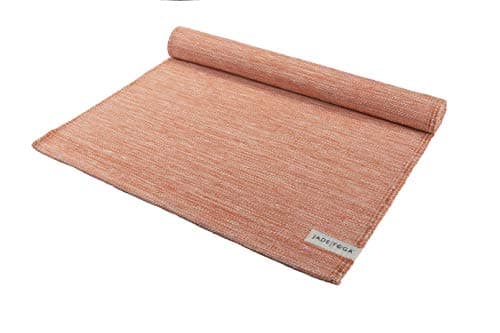
JadeYoga Organic Cotton Mysore Yoga Rug
Machine washable, which matters enormously for something designed to soak up sweat. Narrow, and no padding at all.
$99.95Amazon#ad · Price as of November 3, 2026 · Affiliate disclosure for the link to JadeYoga Organic Cotton Mysore Yoga Rug
The rug that covers a whole mat
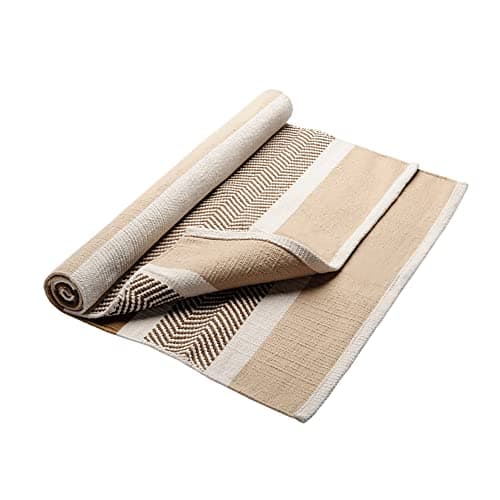
Hugger Mugger Cotton Yoga Rug
Wider and longer, so it overhangs a standard mat instead of leaving the edges bare. Hand wash only.
$70.00Amazon#ad · Price as of November 3, 2026 · Affiliate disclosure for the link to Hugger Mugger Cotton Yoga Rug
The mat side of the argument
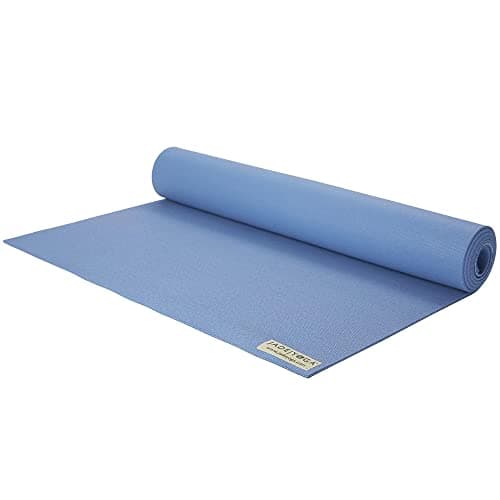
JadeYoga Harmony Mat
Open-cell rubber is the grippiest dry mat surface here, and it cushions. A rug does neither of those things.
$114.95Amazon#ad · Price as of November 3, 2026 · Affiliate disclosure for the link to JadeYoga Harmony Mat
The option people actually mean
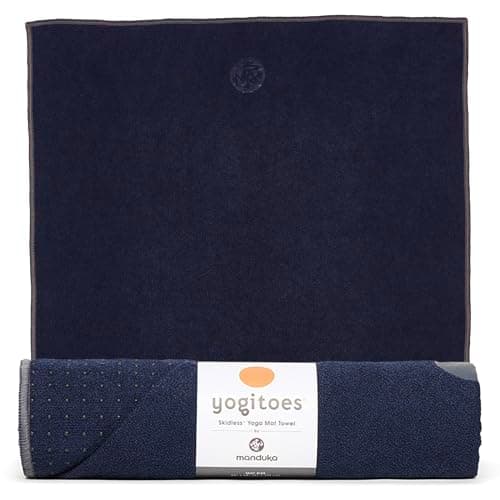
Manduka Yogitoes Skidless Mat Towel
If what you want is a washable layer that grips when wet, a gripper-dot towel does that job with silicone nubs holding it to the mat.
$72.00Amazon#ad · Price as of November 3, 2026 · Affiliate disclosure for the link to Manduka Yogitoes Skidless Mat Towel
The verdict
Buy the mat first. Add a rug only if your problem is sweat. A cotton rug is the one surface in common use that gets grippier as it gets wetter, and that single property is why it survived the arrival of modern mats at all. It is also an eighth of an inch of woven cotton, which means it pads nothing, and on a bare hard floor it slides.
The honest version of this comparison is that they are not competitors. Almost everyone who uses a rug uses it on top of a mat: the mat supplies cushioning and keeps the stack still on the floor, the rug supplies grip that improves as the session goes on. If you are choosing one object to own, it is the mat, and nothing in the rest of this page changes that.
Where a rug genuinely wins outright: you practice somewhere hot, your hands slide off a mat within fifteen minutes, and you want a surface you can throw in the laundry rather than wipe with a cloth. That is a real buyer, and the mat market serves them badly.
Side by side
| Cotton yoga rug | Yoga mat | |
|---|---|---|
| Grip when dry | Fair — cotton on dry skin is unremarkable | Good to excellent |
| Grip when damp | Excellent, and improving | Falls away on most surfaces |
| Cushioning | None — about 1/8 in of fabric | 3 to 12 mm, your choice |
| On a hard floor alone | Slides | Stays put |
| On carpet alone | Works | Works, but can sink |
| Cleaning | Wash the whole thing | Wipe the surface |
| Typical lifespan | Years; it is woven cloth | One to many years, by material |
| Weight | Around 2.5 to 3 lb | 2 to 7 lb |
| Latex | None | Rubber mats contain it |
| What it is really for | Sweat | Everything else |
What a yoga rug is
A yoga rug — usually sold as a Mysore rug or a cotton practice rug — is a flat, tightly handwoven cotton textile roughly the footprint of a mat. There is no foam, no rubber and no coating. The two rugs on this page are woven in India, weigh under three pounds, and are a little over a tenth of an inch thick.
The name comes from Mysore, the Indian city where the Ashtanga lineage is taught, and the rug is standard equipment there rather than a novelty. Specialist rug retailers note that Krishnamacharya worked standing poses on bare floor and seated poses on a carpet, and that the Ashtanga institute in Mysore encourages rugs over mats. If you have ever wondered why the most experienced person in a hot room is on what looks like a tea towel, that is the answer. The sources at the foot of this page are where those claims come from.
What that history does not tell you is whether it suits your floor and your knees, and those are the two questions this page is about.
The grip difference
Every mat surface in ordinary use loses grip as moisture arrives. Closed-cell PVC — the Manduka PRO surface — loses it fastest, because the sweat has nowhere to go and sits in a film between your palm and the mat. Natural rubber holds on longer. Cork holds on longest of the mat materials, and that is exactly why cork has its own list on this site.
Cotton does something none of them does: the fibers take the water in, swell slightly, and the surface turns tacky. There is no film to slide on because the film has been absorbed. Practically, a rug feels mediocre in the first five minutes of a session and better in the fortieth — the reverse of the curve you are used to.
The limit is capacity. A rug is a sponge with a finite volume, and in a genuinely hot room it eventually saturates. At that point it stops improving, stays usable, and needs washing before the next session. That is still a better failure than a slick mat, which is why the hot yoga list leans on absorbent layers rather than clever textures.
The cushioning problem
This is where the rug loses, and it is not close. An eighth of an inch of cotton is, for the purposes of a kneeling pose, the floor. Everything a mat does for your kneecaps, your sitting bones, the side of your foot in a lunge and your forearms in a dolphin plank, a rug does not do.
If you practice on bare concrete, tile or sealed hardwood, a rug alone will hurt. Somebody will tell you that this is traditional and that your body will adapt, and that may even be true for them. It is still the wrong advice for a beginner with a tiled kitchen floor. See the thickness guide for what each band of padding buys you, and mats for sore knees if kneeling is already the thing that stops you.
The other half of the problem is lateral movement. A rug on a hard floor has nothing holding it down. Step back into a lunge and the whole rug travels with your foot. On carpet the pile grips it well enough to be fine, which is the one case where a rug alone genuinely works — and if that is your situation, practicing on carpet has the rest of the setup.
Rug vs mat towel
Most people shopping for a rug actually want a mat towel, so it is worth separating them properly.
| Cotton rug | Gripper-dot mat towel | |
|---|---|---|
| Holds to the mat by | Friction and its own weight | Silicone nubs on the underside |
| Thickness | Woven cloth, no give | Thin microfiber |
| Grip when soaked | Good | Good — the nubs do not care |
| Bunching | Resists it if tightly woven | Resists it well |
| Washing | Machine or hand, by brand | Machine, routinely |
| Standalone use | Works on carpet | Needs a mat |
| Feel underfoot | Firm, textured, cloth | Soft, slightly slippery until damp |
If your single requirement is a washable layer that grips when wet, the towel is the easier answer and it is the one we put top of the sweaty hands list. The rug wins on durability and on being a surface in its own right rather than a cover; the towel wins on not moving, because the nubs do a job that friction cannot.
Who should buy which
- First mat ever, hard floor. A mat. Not a rug, not a rug plus a mat. Start at the beginner picks and find out what actually goes wrong for you.
- Sweaty hands on a mat you otherwise like. A towel first, a rug second. Both sit on the mat you own.
- Ashtanga, or a teacher who asked for a rug. A rug, over your mat. This is the case it was designed for.
- Practicing on carpet. A rug alone is viable here and nothing else on this site is — carpet supplies the padding a rug lacks and the pile stops it traveling.
- You hate wiping a mat down. A rug, because the entire surface goes in the wash. Check which rug: one of the two here is machine washable and the other is not.
- Sore knees. A mat, thicker than you think. A rug makes this worse, not better.
Living with a rug
Three things nobody mentions until you own one.
It needs drying, properly. Cotton that stays damp in a rolled bundle smells within a day or two. A rug lives spread out or over a rail between sessions, exactly like a towel, and that is a real household constraint in a small apartment.
It shrinks and softens. Woven cotton moves on its first wash. The dimensions in the specs are the as-shipped figures and a rug that was a close fit over your mat may not be after a hot wash. Follow the care label rather than the habit.
Natural dyes transfer when new. Rugs colored with plant dyes can give up a little color in the first wash or two. Wash it alone the first time.
None of that is a reason not to own one. It is a reason to be clear about what you are buying: a grippy, washable, long-lived surface with no padding, which is a very good second layer and a poor only layer.
In detail
Both, in full
The rug to buy if you want one
JadeYoga Organic Cotton Mysore Yoga Rug
As the manufacturer lists it · JadeYoga
What it gets right
- Cotton gets tackier as it takes up sweat, which is the opposite of what a PVC mat does
- Machine washable, so the whole surface goes in with the laundry
- Natural dyes and organic cotton rather than a coated synthetic
- Works laid over a mat or straight on a carpeted floor
What it does not
- 26 in wide and 72 in long, so it is no roomier than a standard mat
- No cushioning at all — a knee on a rug on a hard floor is a knee on a hard floor
- Slides on tile or sealed wood unless there is a mat under it
- Cotton holds damp and has to be dried properly between sessions
Skip it if
you want one object that both grips and pads — a rug only does the first half.
#ad · Price as of November 3, 2026 · Affiliate disclosure for the link to JadeYoga Organic Cotton Mysore Yoga Rug
The rug that covers a whole mat
Hugger Mugger Cotton Yoga Rug
As the manufacturer lists it · Hugger Mugger
What it gets right
- 28 in wide, so it covers a 24 in mat with margin on both sides
- Tight weave resists the bunching that makes a loose rug dangerous
- Absorbent enough to be a genuine answer to sweaty hands and feet
- Folds down as a sitting or kneeling pad for seated work
What it does not
- Hand wash and hang dry only, per the maker
- Color availability comes and goes — several shades show as sold out
- An eighth of an inch thick, so it adds grip and no padding
- Needs a mat or a carpet under it on a slick floor
Skip it if
you will not hand wash it — an absorbent surface you never clean is worse than the mat you already own.
#ad · Price as of November 3, 2026 · Affiliate disclosure for the link to Hugger Mugger Cotton Yoga Rug
The mat side of the argument
JadeYoga Harmony Mat
As the manufacturer lists it · JadeYoga
What it gets right
- Hands and feet stop sliding, immediately
- Three lengths, including a genuinely long option
- Jade states it plants a tree for every mat sold
What it does not
- Open cell absorbs sweat and needs drying between sessions
- Sheds a little rubber dust early on
- Wears faster than a closed-cell PVC mat
Skip it if
you practice hot and cannot air the mat properly afterwards.
#ad · Price as of November 3, 2026 · Affiliate disclosure for the link to JadeYoga Harmony Mat
The option people actually mean
Manduka Yogitoes Skidless Mat Towel
As the manufacturer lists it · Manduka
What it gets right
- Turns a slick mat into a usable one for a fraction of a new mat
- Nubs stop the towel creeping mid-flow
- Washes and dries easily
What it does not
- Needs to be genuinely damp to grip best
- Adds a layer to straighten between poses
- Costs as much as a cheap mat
Skip it if
your mat is slippery because it is worn out — replace the mat instead.
#ad · Price as of November 3, 2026 · Affiliate disclosure for the link to Manduka Yogitoes Skidless Mat Towel
What to check before you buy a rug
- Washing instructions, first. This is an absorbent object you will sweat into. Machine washable and hand-wash-only are genuinely different products in daily life, and the difference is not printed on the front of the listing.
- Width against your mat. A standard mat is 24 in wide. A 26 in rug covers it; a 28 in rug overhangs it. A rug narrower than your mat leaves two bare strips exactly where your hands go in a wide stance.
- Weave density. A loose weave bunches, and a bunched rug under a planted hand is a genuine hazard. The tight-weave rugs are heavier for their size, which is a useful proxy.
- Length against your height. The rugs here are 72 and 74 in. If your heels already hang off a standard mat, check the size guide — a rug does not solve a length problem and can make you notice it more.
- What is underneath. Decide this before you buy. Carpet, a mat, or nothing are three different purchases, and “nothing” on a hard floor is the one that does not work.
The mistake people make
Buying a rug as a cheaper alternative to a good mat. It is not cheaper in any meaningful sense, it does not replace what a mat does, and the reader who does this usually ends up buying the mat a month later anyway. Our kit versus piece-by-piece page covers the same trap in the broader setup.
The second mistake is the opposite one: a committed practitioner on a premium closed-cell mat, sliding off it every session, buying a second premium mat. The surface was never going to be the fix. A layer that absorbs is.
How we picked
Chosen on published criteria, and we say so
Most gear sites open by telling you how many hours they spent with the products. We have not used most of these, and we would rather say so than imply otherwise. Every pick here is chosen against criteria we publish — grip, cushioning, size options, what buyers report after a year of use, and whether the thing is still actually sold — and every manufacturer figure on the page is labeled as the maker's claim.
Nobody pays for a place on this page, no product was supplied free in exchange for coverage, and a specification the maker does not publish is never guessed at. See the full criteria and weighting.
FAQ
Questions people ask
Can you use a yoga rug on its own?
Is a cotton yoga rug better than a mat for hot yoga?
How do you wash a yoga rug?
Do yoga rugs bunch up?
What is a Mysore rug?
Related
Keep reading
Update log
What changed
- First published.
Receipts
Sources
- 1.JadeYoga — Organic Cotton Mysore Yoga Rug (size, weight, care)
- 2.Hugger Mugger — Cotton Yoga Rug (size, weight, care)
- 3.Yogishop — yoga rugs: what they are and why Ashtanga rooms use them
- 4.JadeYoga — product information
- 5.Hugger Mugger — product information
- 6.Manduka — Yogitoes mat towels
- 7.OutdoorGearLab — The Best Yoga Mats
We have not used every product on this page, and we do not pretend otherwise. Thicknesses, materials, sizes and warranty terms are the manufacturer's published figures, shown as their claims. Anything about materials, skin or injury is linked to a source. Prices are set by Amazon and change constantly, so we never type one into the text — every figure comes from Amazon's own data, dated, and disappears rather than going stale. Read the full method.