Blocks, Straps & Props Best picks
The Best Meditation Cushions
Almost nobody can sit cross-legged on a flat floor for ten minutes without their back rounding. A cushion fixes that by raising one end of you, and the only question is how far.
We earn a commission when you buy through links on this page, at no extra cost to you. It never decides a ranking: the method is published. How we are funded
Quick picks
The short answer
1 · Best first cushion
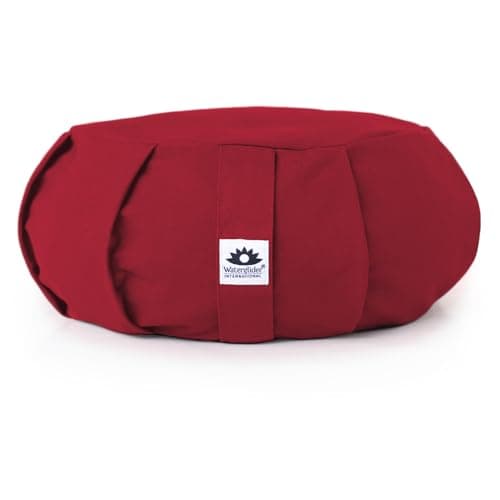
Waterglider International Zafu, Eclipse LineThe plain round zafu with buckwheat you can pour out. Start here, because the height you need is something you discover by sitting rather than by measuring.
Maker lists shape: Round zafu
2 · Best published build
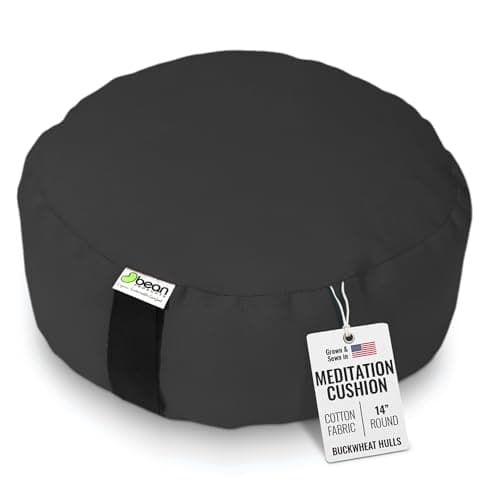
Bean Products Round Zafu, 14 inThe only cushion here with a stated diameter, a stated cover fabric and a liner that lets you wash the cover without a spill. The one to buy if you expect to keep it.
Maker lists diameter: 14 in
3 · Best for high knees
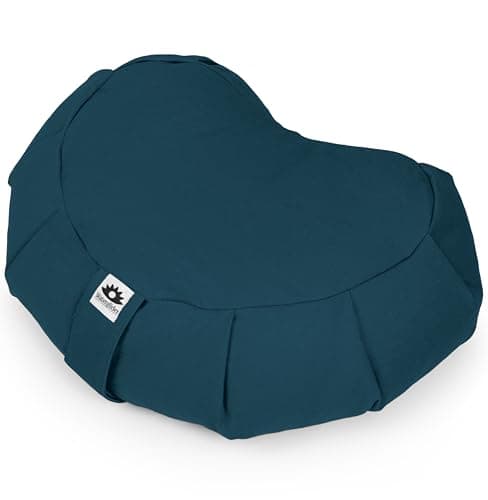
Waterglider International Crescent CushionSame fill, front scooped out, so your thighs angle down instead of being propped level. The right answer when height alone has not settled your knees.
Maker lists shape: Crescent
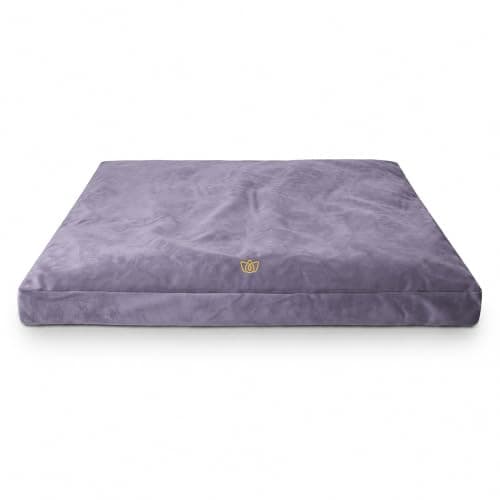
4 · Best for sore ankles
Florensi Zabuton Meditation MatNot a seat at all — the padded square that goes under the cushion, for the ankle bone and the outer knee that a hard floor presses into.
Maker lists size: 32 x 32 in
#ad · Prices come live from Amazon, last checked November 3, 2026. Figures here are the manufacturer's own. The ranking is editorial, made against the criteria on our How We Pick page, not from lab work. Photos come from Amazon. Tap a pick for the full write-up.
The short answer
Buy a round buckwheat zafu and sit on the front third of it. That is the whole category for most people. A meditation cushion has one job: lift your hips higher than your knees so your pelvis tips forward and your lower back keeps its natural curve instead of collapsing backward. Everything else — the fabric, the shape, the brand — is a refinement of that one measurement.
The reason this matters more than it sounds is that the discomfort people blame on meditation is usually just a geometry problem. Sit flat on the floor with your legs crossed and your pelvis rolls back, your lumbar spine rounds, and within about four minutes your lower back starts to ache and your feet go numb. Raise your hips by a few inches and the same position becomes something you can hold without effort. That is the entire mechanism, and it is why a cushion is one of the few props in this whole category that is genuinely difficult to regret.
What actually decides it
Four things separate these cushions, and only the first two change how sitting feels:
- Height. How far the cushion lifts your hips. This is the single most important specification and the one almost no maker publishes. Buckwheat solves it by being pourable: you take fill out until the height is right.
- Shape. A round zafu lifts you evenly. A crescent has the front cut away so your thighs can angle down rather than being held level. If your knees stay stubbornly higher than your hips, the shape is the fix, not more height.
- Fill. Buckwheat hulls, kapok, or foam. Buckwheat is adjustable and firm and heavy; kapok is springier and cannot be adjusted in the same way; foam is cheap and compresses to nothing within months of daily use.
- Whether the cover comes off. This is an object that lives on the floor and gets sat on daily by someone who has just walked across a room. A cover that comes off is the difference between a cushion you keep and one you quietly replace.
Notice what is not on that list: how it looks, what it is embroidered with, and whether it matches anything. Those are real reasons to prefer one cushion over another and they are not reasons to pay more, because a cushion that sits you at the wrong height is uncomfortable in any fabric.
How high should it be
The honest answer is that it depends on your hip flexibility, and the useful answer is that you can find out for nothing before you spend anything. Stack two firm pillows or a folded blanket on the floor, sit on the front edge with your legs crossed, and look at where your knees are relative to your hips. Knees level with or below the hip crease means the height is right. Knees above the hips means go higher. A lower back that rounds backward means go higher. A sense that you are perched and tipping forward means go lower.
| Too low | About right | Too high | |
|---|---|---|---|
| Knees | Above the hip crease | Level or below | Dropped, but hips feel unstable |
| Lower back | Rounds backward | Keeps its natural curve | Arches and tires |
| First ten minutes | Aches, feet numb | Unremarkable | Fine, then the hips fidget |
| What to change | More height, or a crescent | Nothing | Pour out some fill |
This is the argument for buckwheat over every other fill, and it is close to the only argument that matters. A buckwheat cushion ships overfilled. You open the liner, pour hulls into a bag, zip it up and sit again. Three iterations over a week and you have a cushion built for your hips. No other fill lets you do that, and no amount of reading will tell you the number in advance.
One practical note on the same theme: sit on the front third of a round cushion rather than in the middle of it. Sitting centered lifts your whole pelvis evenly, which does nothing for the forward tilt you are after. Sitting forward puts the high point behind your sit bones and tips you the right way, which is why the same cushion feels different depending on where you land on it.
Round, crescent or neither
The round zafu is the default and should be your first assumption. It works cross-legged, it works kneeling with the cushion turned on its edge between your heels, and it works as a prop under a knee or behind a back. It is the general-purpose shape.
A crescent exists for one specific failure. Some people raise their hips to a sensible height and their knees still float, because the front of a round cushion holds the thighs horizontal. Cutting that front away lets the thighs angle downward from the hip, and the knees settle several inches lower without any extra height. If you have tried a tall cushion and your knees are still in the air, this is the shape to buy next — and it is the shape to skip entirely if a round one already works, because it is less useful for everything else.
There is a third option nobody sells as a meditation cushion: a block. A cork or foam block on its tallest setting is a hard, narrow, roughly zafu-height seat, and for a five-minute sit at the end of a practice it is perfectly adequate. We make the case for having two of them in whether blocks are worth it; if you own blocks already, try one before you buy anything, because it will tell you the height question for free.
Buckwheat, kapok and foam
Buckwheat hulls are what every cushion in this list that you actually sit on is filled with, and the reason is that hulls do not compress. They shift and interlock and then stop, so the cushion holds a stable shape under you instead of slowly sinking for the length of a sit. They are adjustable, as above, and they are heavy — a full zafu is a surprisingly substantial object to carry anywhere.
Kapok is a plant fiber, lighter and springier, and it is the traditional fill for a zabuton rather than a zafu. It feels softer at first and it packs down over time, and because it packs down as a mass rather than as pourable grains you cannot tune the height. Fine for a mat under you, second-best for a seat.
Foam is what inexpensive decorative floor cushions use. It is comfortable for about a month of daily sitting and then it is a flat pancake of foam. If a cushion does not say what is inside it, assume foam.
The mat underneath
The second purchase, and the one people are most surprised by, is a flat padded square to put the cushion on. It is called a zabuton, and it exists because raising your hips solves your back and does nothing for the parts of you that are still pressed into a hard floor: the outside of each knee, each ankle bone, and the top of a foot if you kneel.
You do not need one if you sit on carpet, and you do not need one if you put the cushion on your yoga mat — a 5 mm mat is not much padding but it is enough for most ankles. You want one if you sit on wood, tile or concrete, if you sit for longer than about fifteen minutes, or if you kneel. The symptom to watch for is that your back is fine and one specific bone hurts. That is a zabuton problem, not a cushion problem.
A folded blanket does most of this job, and it is the cheaper experiment. A thick yoga blanket folded in quarters under a zafu will tell you within a week whether you need a dedicated mat, and it stays useful afterward either way — see the blankets we pick for the ones that hold a fold rather than spreading out under you.
What you may already own
Three things in an ordinary home do a version of this, and it is worth trying them before you spend anything, because they also tell you what height to buy:
- A firm sofa cushion. Usually about the right height and far too soft, which is exactly the comparison that explains why buckwheat is worth paying for. If a sofa cushion helps your back but feels unstable, a zafu is the fix.
- A yoga bolster, on its end. A rectangular bolster stood up or laid under the hips is firm, tall and already in a lot of houses. It is bulkier than a zafu and it works. Whether you need a bolster covers the rest of what one is for.
- A stack of folded blankets. The traditional answer, free, and infinitely adjustable in roughly one-inch steps. The drawback is that it slides apart as you shift, which is the specific thing a single filled cushion does better.
These are not consolation prizes. A reasonable, cheap, perfectly serious seated setup is a folded blanket on a yoga mat, and the only reason to upgrade is that a cushion holds its shape and a blanket stack does not.
In detail
Every pick, in full
1
Best first cushion
Waterglider International Zafu, Eclipse Line
As the manufacturer lists it
What it gets right
- Buckwheat fill can be removed by the handful, so the height is yours to set
- Cover comes off, which matters on a cushion that lives on the floor
- Round shape suits cross-legged sitting and kneeling equally
What it does not
- The brand publishes no height or diameter anywhere we could find
- Buckwheat is heavy — this is not a cushion you carry to a class
- Firm rather than plush, which some people dislike on a first sit
Skip it if
your knees sit higher than your hips even on a tall cushion — a crescent frees the thighs in a way a round one cannot.
#ad · Price as of November 3, 2026 · Affiliate disclosure for the link to Waterglider International Zafu, Eclipse Line
2
Best published build
Bean Products Round Zafu, 14 in
As the manufacturer lists it · Bean Products
What it gets right
- Published diameter, published fill, published cover fabric — rare in this category
- Cotton canvas is the fabric that survives being sat on daily
- Designed to be emptied, washed and refilled
- An inner liner holds the hulls, so the cover comes off without a spill
What it does not
- The maker does not publish a loft height, so you cannot plan the sit height in advance
- Canvas is hard-wearing rather than soft to the touch
- Costs noticeably more than the generic round cushions
Skip it if
you want something soft and decorative for a living room rather than a working prop.
#ad · Price as of November 3, 2026 · Affiliate disclosure for the link to Bean Products Round Zafu, 14 in
3
Best for high knees
Waterglider International Crescent Cushion
As the manufacturer lists it
What it gets right
- The cut-away front lets the thighs angle down, which is what settles the knees
- Tips the pelvis forward without you having to hold it there
- Same removable-fill construction as the round version
What it does not
- Only works in one orientation, so it has to be placed deliberately
- Less useful than a round cushion for kneeling or for propping anything else
- No published dimensions
Skip it if
you sit comfortably on a round cushion already — the shape solves a problem you do not have.
#ad · Price as of November 3, 2026 · Affiliate disclosure for the link to Waterglider International Crescent Cushion
4
Best for sore ankles
Florensi Zabuton Meditation Mat
As the manufacturer lists it
What it gets right
- Square big enough that both knees and both ankles land on padding
- Turns a hard floor into a sittable surface without raising your hips
- Doubles as a kneeling pad for floor work away from the mat
What it does not
- Bulky — it does not fold small and it does not hide easily
- Velvet collects dust and lint and is not a wipe-clean surface
- Does nothing at all for hip height, so you still need a cushion on top
Skip it if
you sit on carpet, or you already sit on your yoga mat — both do most of this job for nothing.
#ad · Price as of November 3, 2026 · Affiliate disclosure for the link to Florensi Zabuton Meditation Mat
What to look for
- Buckwheat, and a liner. Hulls in an inner liner mean you can take the cover off without a kitchen-floor accident. Hulls loose inside a single cover mean you cannot wash it.
- A cover that comes off. Non-negotiable on an object that lives at floor level. Check whether the maker says hand wash or machine wash, because several say hand wash only.
- A published diameter, if you can get one. Most of this category publishes nothing. Where a size is stated, a 13 to 15 inch round is the standard and a smaller one will feel perched.
- Firm cotton or canvas over decorative velvet, if you are buying one cushion to use daily. Velvet looks better in a room and collects every piece of lint in it.
- Nothing you cannot refill. Buckwheat settles over a year or two of daily use. A cushion you can top up lasts indefinitely; a sealed one does not.
One honest caveat about where a cushion does not help. If what hurts is the front of your ankle or the outside of your knee rather than your back, height is not your problem and a taller cushion makes it slightly worse by increasing the angle at the knee. That is the padding-underneath problem described above. And if your knees hurt specifically when you kneel rather than when you sit cross-legged, the cheapest fix in this whole category is a thick foam strip — the knee pads page covers it.
Finally, on where this sits in a buying order: it does not belong near the front of one. A mat and two blocks do more for a new practice than a cushion does, and the beginner kit sets out why. Buy a cushion when sitting still has become something you actually do, not in anticipation of it.
How we picked
Chosen on published criteria, and we say so
Most gear sites open by telling you how many hours they spent with the products. We have not used most of these, and we would rather say so than imply otherwise. Every pick here is chosen against criteria we publish — grip, cushioning, size options, what buyers report after a year of use, and whether the thing is still actually sold — and every manufacturer figure on the page is labeled as the maker's claim.
Nobody pays for a place on this page, no product was supplied free in exchange for coverage, and a specification the maker does not publish is never guessed at. See the full criteria and weighting.
FAQ
Questions people ask
How high should a meditation cushion be?
Do I need a zabuton as well as a cushion?
Is a round zafu or a crescent better?
Can I use a yoga bolster instead?
Why do my feet go numb when I sit cross-legged?
How do I wash a meditation cushion?
Related
Keep reading
Update log
What changed
- First published.
Receipts
Sources
- 1.Bean Products — Zafu meditation cushion (fill, cover fabric, care, where it is sewn)
- 2.NCCIH (US National Institutes of Health) — Meditation and Mindfulness: What You Need To Know
- 3.NCCIH (US National Institutes of Health) — Yoga: What You Need To Know
- 4.Hugger Mugger — product information
- 5.NBC Select — The best yoga props and apparel
We have not used every product on this page, and we do not pretend otherwise. Thicknesses, materials, sizes and warranty terms are the manufacturer's published figures, shown as their claims. Anything about materials, skin or injury is linked to a source. Prices are set by Amazon and change constantly, so we never type one into the text — every figure comes from Amazon's own data, dated, and disappears rather than going stale. Read the full method.