Blocks, Straps & Props Best picks
The Best Yoga Knee Pads
The cheapest fix in this whole category. Rather than buying a thicker mat and losing your balance on it, you put a thick pad under the one joint that hurts.
We earn a commission when you buy through links on this page, at no extra cost to you. It never decides a ranking: the method is published. How we are funded
Quick picks
The short answer
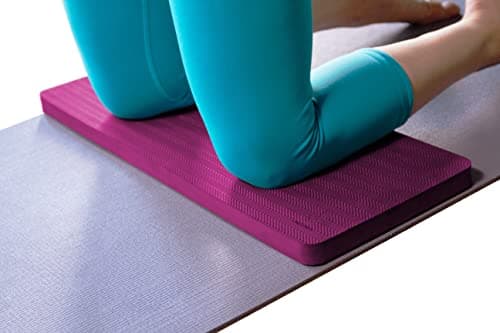
1 · Best first pad
SukhaMat Yoga Knee PadThe standard thickness, the standard size and the pad most people mean when they say knee pad. Start here unless you already know it is not enough.
Maker lists format: Small pad used on top of a mat
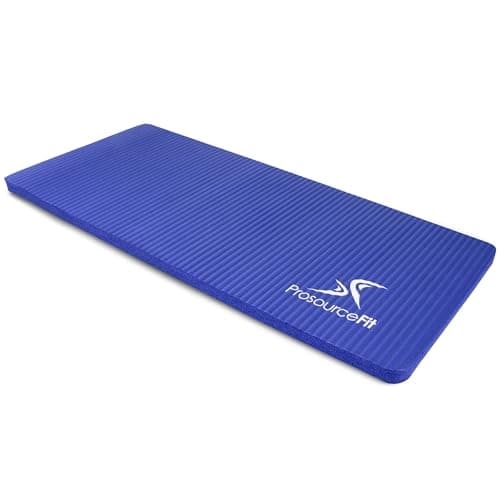
2 · Best published specs
ProsourceFit Yoga Knee and Elbow PadThe same format from a brand that prints its dimensions, foam type and care instructions rather than leaving you to guess.
Maker lists dimensions: 24 in L x 10 in W x 5/8 in H (maker)
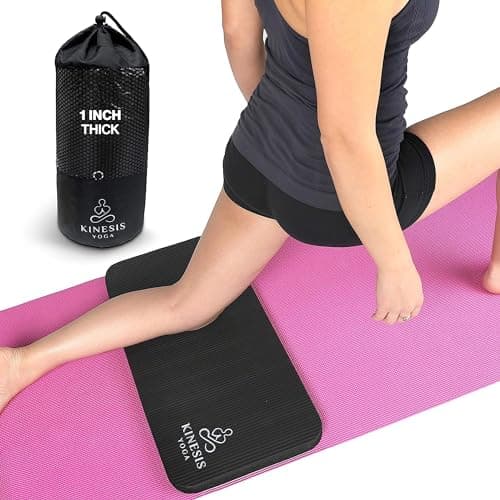
3 · Most cushion available
Kinesis Yoga Knee Pad Cushion 25mmRoughly double the usual depth. The right answer when a standard pad still leaves you shifting your weight, and too tall when it does not.
Maker lists thickness: 1 in (25 mm), as the listing states
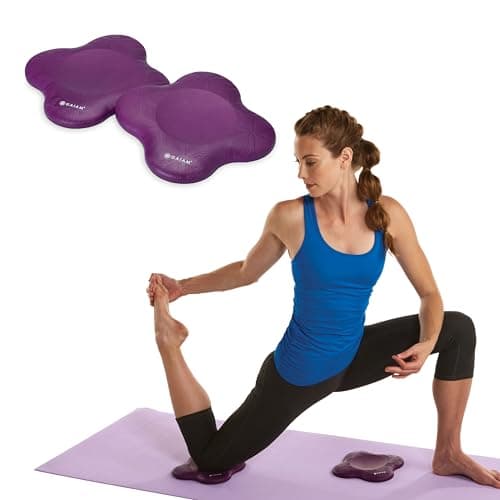
4 · Best for one joint at a time
Gaiam Yoga Knee Pads Set of 2Two small round cushions rather than one long strip, which suits a single kneeling knee or an elbow better than a mat-width pad does.
Maker lists format: Two round pads, sold as a pair
#ad · Prices come live from Amazon, last checked November 3, 2026. Figures here are the manufacturer's own. The ranking is editorial, made against the criteria on our How We Pick page, not from lab work. Photos come from Amazon. Tap a pick for the full write-up.
The short answer
Buy one standard pad at about 15 mm and put it where it hurts. That is the whole category. A knee pad is a short, very thick strip of dense foam you lay on top of your mat for the parts of a class that put your body weight through a small joint — kneeling lunges, tabletop, camel, anything on the elbows.
It is worth understanding why this beats the obvious alternative. The instinctive fix for sore knees is a thicker mat, and a thicker mat makes standing balance worse everywhere: the same compression that spares your kneecap lets your standing foot sink and roll. A pad concentrates the cushion under the joint that needs it and leaves the rest of the mat firm, which is the right trade for almost everyone. We argue the same point from the other direction in the thickness guide.
What actually decides it
Four things separate these pads, and only the first two matter much:
- Thickness. The standard is about 15 mm, which is roughly three times a normal mat. One pad here goes to 25 mm. More is not automatically better, for reasons in the next section.
- Shape. One long strip the width of a mat, or two small round cushions. The strip covers both knees at once and stays put; the pair lets you place cushion exactly where it hurts.
- Foam density. Every pad in this list is NBR or a similar closed-cell foam. Dense foam that resists compression beats soft foam that bottoms out, and the practical test is whether your kneecap can feel the floor through it when you press down hard.
- Whether it stays where you put it. A pad on a brand-new closed-cell PVC mat slides, because two slick surfaces have nothing to grip. This is the complaint people actually have, and it is about the mat as much as the pad.
Notice what is not on that list: brand, color, and whether it comes with a carry strap. A knee pad is a rectangle of foam. There is very little engineering to get right and very little to get wrong, which is why the differences below are genuinely small and why the cheapest pad that is thick enough is usually the correct purchase.
How thick, and when thicker is worse
| About 15 mm | About 25 mm | |
|---|---|---|
| Kneeling on a hard floor | Comfortable for most people | Comfortable for almost everyone |
| Low lunge stability | Barely affected | Noticeably tips you forward |
| Elbows and forearms | Adequate | Better |
| Rolls inside a mat | Easily | Adds real bulk |
| Risk of being too much | Low | Real |
The second column is the interesting one. A 25 mm pad is a step up at a hard floor, and it also raises one knee an inch above the other in any asymmetric kneeling pose. In a low lunge that changes the angle at your hip, and in a half-kneeling twist it changes where your weight falls. Neither is dangerous and both are noticeable.
So the order is: start at the standard thickness, and go thicker only if the standard one does not solve it. Reversing that order is how people end up with a pad that fixed the pain and introduced a wobble.
A second, cheaper experiment is worth running first. Fold a blanket into quarters and kneel on that for a week. If the folded blanket fixes the problem, a pad will too, and you now know the thickness you want without having bought anything. If the blanket does not fix it because it slides and compresses flat, that is the specific thing a dense foam pad does better — though a loose-woven throw and a dense prop blanket behave very differently here, and it is worth knowing which one you tested with.
One long pad or two small ones
A long strip is the default, and it is the default for a good reason: it covers the full width of your mat, so both knees land on it in tabletop without anyone aiming. You put it down once at the top of your mat and forget it. The cost is that it is one object the size of a folded towel, and in a pose that puts only one knee down, most of it is unused.
A pair of small round cushions inverts that trade. Each one sits exactly under the joint you are protecting — one knee in a kneeling lunge, one elbow in a side plank, a hand in a wrist-sparing variation — and two of them cover both knees when you want that. The cost is that they are two small loose objects which can be kicked out of position mid-flow, and a knee that drifts lands on the mat rather than the cushion.
If you are not sure, take the strip. It is the lower-maintenance of the two and the one that does not ask you to think about placement while you are already in a pose. Take the pair if your problem is specifically one joint, or if you also want something to put under an elbow.
What a pad replaces
Three things do a similar job, and it is worth knowing which one you actually need before you buy foam:
- A thicker mat. Solves kneeling and degrades balance. Worth it if kneeling is most of what you do — see the mats we pick for sore knees, which exist for exactly this reader.
- A folded blanket. Free, and genuinely adequate for gentle practice. It slides on a slick mat and compresses under real weight, which is the gap a pad fills.
- A block, on its side. Not a cushion at all. A block under a hand or a hip changes the geometry of a pose so your knee carries less; that is a different fix and often a better one. The full case is in how to use yoga blocks.
These stack rather than compete. A reasonable setup for painful knees is a firm mat at a normal thickness, one pad for the kneeling work and two blocks to take weight out of the poses that still hurt. That costs less than one premium mat and solves more.
In detail
Every pick, in full
1
Best first pad
SukhaMat Yoga Knee Pad
As the manufacturer lists it
What it gets right
- Targets the padding where you actually need it
- Leaves the rest of the mat firm for balancing
- Small enough to keep in a bag
What it does not
- One more thing to move around mid-practice
- Can slide on a slick mat
- Not useful if your problem is wrist pain in plank
Skip it if
you want one surface and no extra pieces — get a 6 mm mat instead.
#ad · Price as of November 3, 2026 · Affiliate disclosure for the link to SukhaMat Yoga Knee Pad
2
Best published specs
ProsourceFit Yoga Knee and Elbow Pad
As the manufacturer lists it · ProsourceFit
What it gets right
- Long enough to cover both knees side by side
- Maker publishes real dimensions and care instructions
- Light enough to live in a mat bag
What it does not
- NBR foam can smell for the first week
- Plain surface slides on a slick closed-cell mat
- No carry strap or bag
Skip it if
you want something that stays put on a brand-new PVC mat without being reset.
#ad · Price as of November 3, 2026 · Affiliate disclosure for the link to ProsourceFit Yoga Knee and Elbow Pad
3
Most cushion available
Kinesis Yoga Knee Pad Cushion 25mm
As the manufacturer lists it
What it gets right
- Enough depth to take kneeling off the table as a problem
- Firm rather than squashy, so it does not bottom out
- Works under elbows and forearms as well as knees
What it does not
- The height tips you forward in a low lunge
- Bulky to roll inside a mat
- Overkill if a standard pad already works
Skip it if
a standard pad already fixes it — the extra height is a nuisance you do not need.
#ad · Price as of November 3, 2026 · Affiliate disclosure for the link to Kinesis Yoga Knee Pad Cushion 25mm
4
Best for one joint at a time
Gaiam Yoga Knee Pads Set of 2
As the manufacturer lists it · Gaiam
What it gets right
- A pair means both knees are covered without a long pad
- Small enough to place exactly where it hurts
- Packs flatter than a rolled pad
What it does not
- Two loose objects to track instead of one
- Too small to catch a knee that moves mid-pose
- Less total cushion than a thick single pad
Skip it if
you want one thing to put down and forget about.
#ad · Price as of November 3, 2026 · Affiliate disclosure for the link to Gaiam Yoga Knee Pads Set of 2
What to look for
- At least mat-width, if you want a strip. A pad narrower than your mat has to be aimed, which defeats the purpose. The common size is about 24 by 10 inches.
- Density over depth. Press a thumb into the pad hard. If you can feel the floor, the foam is too soft, and no amount of thickness fixes soft foam.
- Expect a smell for the first week. NBR foam off-gasses. Unroll it somewhere ventilated for a few days before you decide you hate it — this is the same phenomenon as a new mat smelling, and it passes.
- Check how it is cleaned. Most of these are wipe-clean only and not machine washable, and a pad that lives under your knees gets grubby faster than the mat does.
- Do not pay for a carry bag. A knee pad is a home object. If you are carrying one to a studio, it rolls inside your mat.
One honest caveat about where a pad does not help. If what hurts is your wrists in plank and downward dog rather than your knees on the floor, a cushion is the wrong tool — soft foam under a loaded wrist makes it less stable, not more. That problem wants rigidity, which is what the wrist-pain blocks are for.
And if you are still assembling a first setup rather than patching a specific complaint, a pad is not among the first things to buy. The beginner kit sets out the order that makes sense, and a mat and two blocks come well before foam for your knees.
How we picked
Chosen on published criteria, and we say so
Most gear sites open by telling you how many hours they spent with the products. We have not used most of these, and we would rather say so than imply otherwise. Every pick here is chosen against criteria we publish — grip, cushioning, size options, what buyers report after a year of use, and whether the thing is still actually sold — and every manufacturer figure on the page is labeled as the maker's claim.
Nobody pays for a place on this page, no product was supplied free in exchange for coverage, and a specification the maker does not publish is never guessed at. See the full criteria and weighting.
FAQ
Questions people ask
Do I need a yoga knee pad?
How thick should a yoga knee pad be?
Is a knee pad better than a thick yoga mat?
Why does my knee pad slide on my mat?
Can I use a knee pad for my elbows and wrists?
Related
Keep reading
Update log
What changed
- First published.
Receipts
Sources
- 1.ProsourceFit — Yoga Knee Pad (published dimensions, foam type and care instructions)
- 2.SukhaMat — published thickness and materials for its yoga knee pad
- 3.Gaiam — product information
- 4.NBC Select — The best yoga props and apparel
- 5.NCCIH (US National Institutes of Health) — Yoga: What You Need To Know
We have not used every product on this page, and we do not pretend otherwise. Thicknesses, materials, sizes and warranty terms are the manufacturer's published figures, shown as their claims. Anything about materials, skin or injury is linked to a source. Prices are set by Amazon and change constantly, so we never type one into the text — every figure comes from Amazon's own data, dated, and disappears rather than going stale. Read the full method.