Pilates at Home Best picks
The Best Pilates Equipment for Home
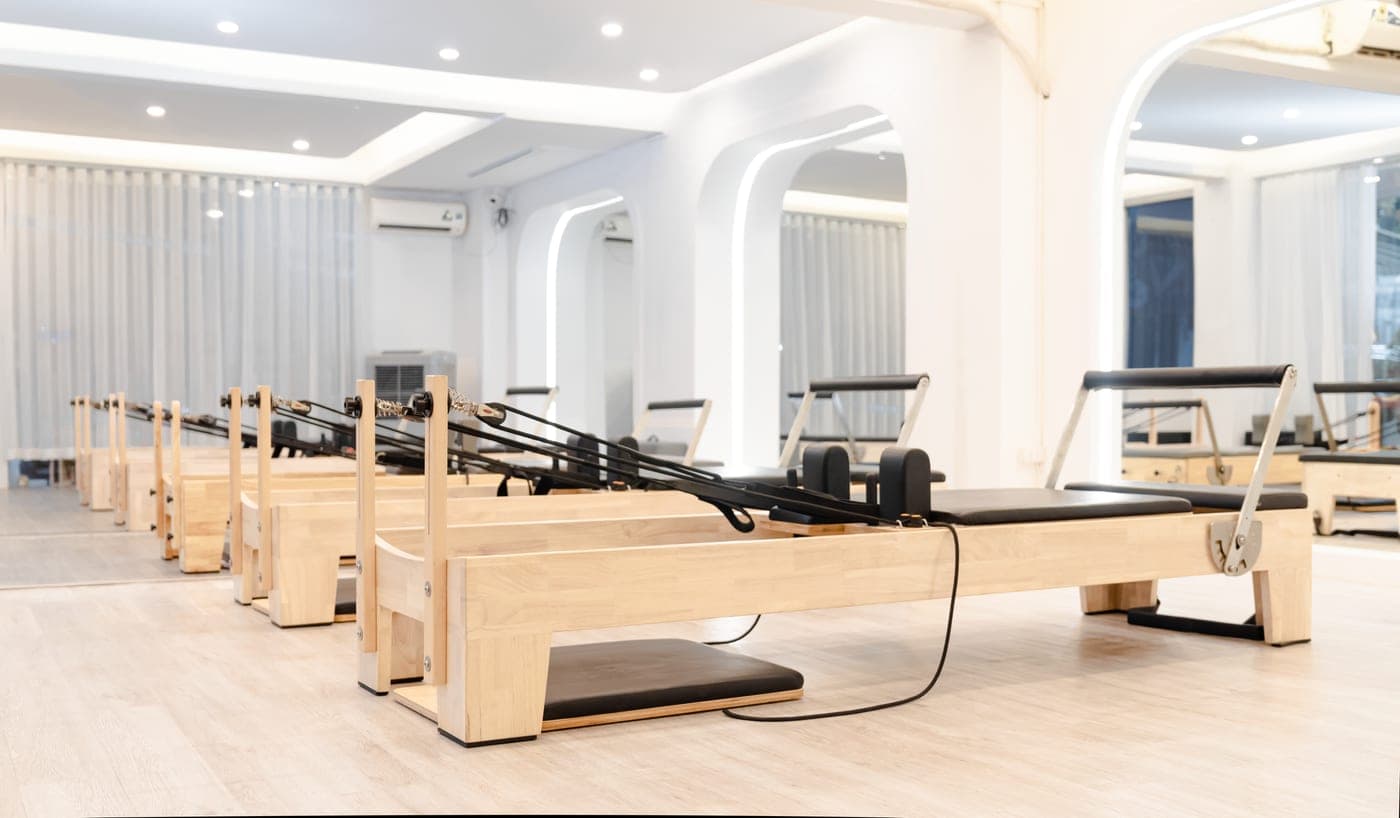
Almost the entire Pilates repertoire was written for a body on a floor. The equipment that follows is a sequence, not a shopping list — and the machine belongs at the end of it.
We earn a commission when you buy through links on this page, at no extra cost to you. It never decides a ranking: the method is published. How we are funded
Quick picks
The short answer
1 · Buy this first
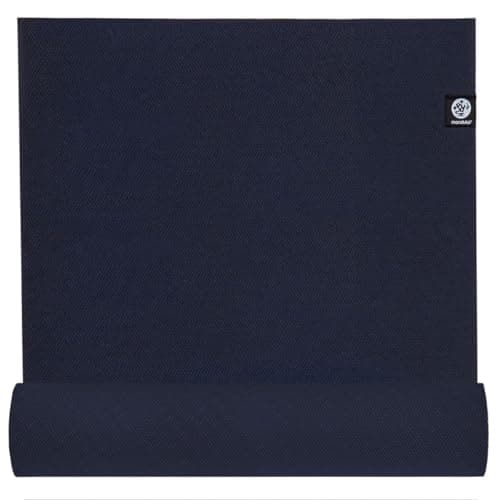
Manduka X Mat 5mmDense, closed-cell and textured on both faces, which is what rolling and shifting weight asks for. Mat Pilates is the whole repertoire, and this is the floor it happens on.
Maker lists thickness: 5 mm
2 · Best first resistance
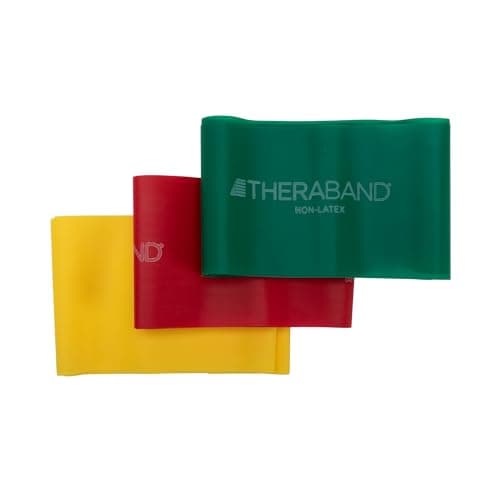
THERABAND Non-Latex Bands, Beginner SetA flat band in three grades. It sits across a foot or a thigh without digging in, and the yellow-red-green order is the one clinical instructions are written around.
Maker lists bands: Three: yellow, red, green
3 · Best box of small props
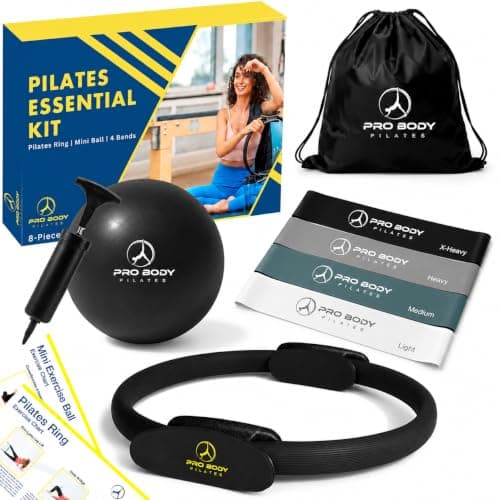
ProBody Pilates Ring, Ball and Band KitRing, mini ball, bands and a pump together. If you would rather make one purchase than four, this is most of the small-equipment list at once.
Maker lists included: 14 in ring, 9 in ball, resistance bands, pump and bag
4 · Budget pick
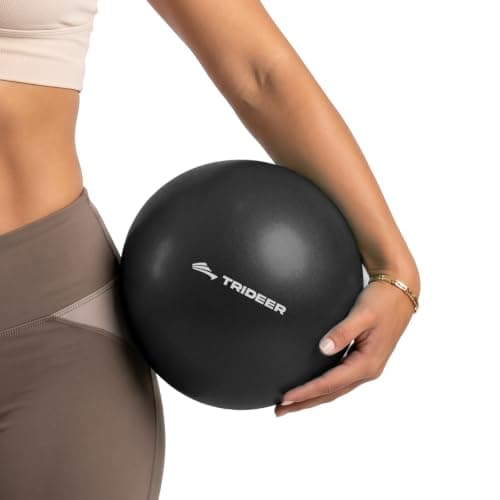
Trideer Pilates Ball 9 inThe cheapest thing here and the prop a beginner mat class asks for most often. Nine inches, textured so it stays put between the knees, flat in a drawer afterward.
Maker lists diameter: 9 in
5 · Best step toward spring work
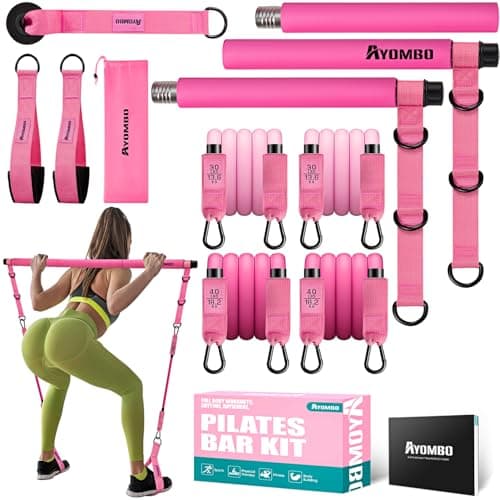
Ayombo 3-Section Pilates Bar KitThe cheapest way to get pulling and pressing resistance standing up rather than lying down. It is not a carriage, and the bands load differently from springs.
Maker lists bar: Three sections, assembled by screwing together
6 · Best route to a machine
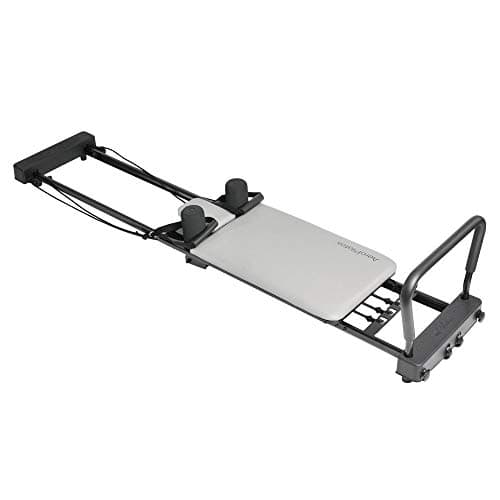
AeroPilates Reformer 287Cords rather than springs, a rebounder built in, and it folds. The honest entry point if you have decided you want a machine, with the caveat that it does not feel like a studio reformer.
Maker lists resistance: Three-cord system
#ad · Prices come live from Amazon, last checked November 28, 2026. Figures here are the manufacturer's own. The ranking is editorial, made against the criteria on our How We Pick page, not from lab work. Photos come from Amazon. Tap a pick for the full write-up.
The short answer
Buy a dense mat, then one flat resistance band, and start. That is a complete home Pilates setup, and for a lot of people it stays complete for a year. The Manduka X is the mat because it is firm and textured on both faces, which is what rolling, kneeling and shifting weight actually need; the THERABAND flat set is the band because the flat shape is what the mat repertoire calls for and the three grades let you keep an exercise and change the load.
The mini ball is the budget pick and the prop a beginner class names more often than anything else. A bar comes later, and only if standing resistance is the thing you are missing. A machine comes last, or never — and the folding AeroPilates 287 is the honest entry point rather than the cheapest studio-feel reformer, because no cheap machine feels like the one in your class.
The order that makes sense
Pilates equipment is unusual among home fitness categories in that the expensive end is genuinely optional. Joseph Pilates wrote the mat sequence first and the apparatus second, and the mat sequence is still the backbone of most beginner classes. That has a practical consequence: every piece below is bought to solve a problem the previous piece created, and buying out of order leaves you with equipment that duplicates what you already own.
- A mat you can roll on. Not a yoga mat chosen for grip — a mat chosen for density, because spinal articulation drags your vertebrae along the floor. Mats for Pilates has the full argument.
- One flat band. The cheapest thing that changes what you can do. Arms, legs, feet, and a hundred class cues that assume you have one.
- A mini ball, a ring, or the box that holds both. These are refinements, not foundations: each one makes a specific family of exercises harder or clearer.
- A bar. The first piece that works standing and kneeling rather than lying down, which is the genuine gap in a mat-only setup.
- Sliders or light ankle weights. Cheap, small, and they add load without adding footprint. Covered in the sliders roundup and the ankle-weight roundup.
- A machine, if you are sure. A board or a full reformer. This is a different size of decision, and it gets its own section below.
If that order looks slow, it is deliberately slow. The most common expensive mistake in this category is buying a machine in month one, discovering in month three that the habit did not stick, and selling it at a loss — and that is a mistake a mat and a band cannot make.
What each piece actually adds
The useful way to compare Pilates equipment is not by price or by brand, but by which part of the repertoire it opens up. The table below is that comparison.
| Piece | What it unlocks | What it does not do |
|---|---|---|
| Dense mat | The entire mat repertoire: rolling, articulation, kneeling work | Nothing for resistance or range |
| Flat band | Arm, leg and foot resistance; assisted stretching | No standing load, no carriage glide |
| Mini ball | Inner-thigh squeezes, lumbar support, feedback on alignment | Not a seat, and not a stability ball |
| Magic circle (ring) | Squeeze-and-release work for arms and adductors | Little for the back or the spine |
| Pilates bar | Pulling and pressing from standing, kneeling and seated | No moving carriage; band load rises through the range |
| Reformer board | Carriage-style sliding on the floor | No footbar height changes, far less resistance range |
| Full reformer | Springs, straps, footbar, carriage — the studio repertoire | Takes real floor space and real money |
Two things fall out of that table. First, the cheap items are not junior versions of the expensive ones: a band and a reformer do genuinely different jobs, and owning the band does not make you want the machine less. Second, the ring and the mini ball overlap more than their marketing suggests, which is exactly why the three-in-one box is ranked where it is — ring versus ball works through that choice if you would rather buy one.
The machine question
Everything above fits in a drawer and costs less than a couple of months of studio classes. The machine is a different kind of purchase, and three questions settle it honestly.
Do you have the floor? A full reformer needs its footprint plus clearance at both ends for the straps and the footbar, and that clearance is the part people forget. Reformer space requirements has the measurements, and it is worth taping the outline on your floor before you order anything.
Do you want the studio feel, or the movement? If you want the machine in your living room to behave like the machine in class, a cord-resistance folding model will disappoint you — the resistance curve is different and the footbar does not adjust the same way. If you want the sliding-carriage movement at home and can accept that it feels different, a folding machine or a board does that. Folding reformers and reformer boards cover each route.
Has the habit stuck? This is the one that matters most and gets asked least. Is a reformer worth it treats it as a commitment question rather than a specification question, and what a reformer costs explains what separates the tiers without quoting numbers that would be stale by the time you read them.
If the answer to any of the three is no, the useful move is not to buy a cheaper machine. It is to buy a bar and keep the money — reformer alternatives ranks what actually substitutes for which part of the machine, and Pilates without a reformer answers the prior question plainly.
What you can skip
A surprising amount of what gets sold as Pilates equipment is either a duplicate or a different sport altogether.
- A full-size stability ball, early on. It is a useful piece of equipment and a poor first purchase: it does not deflate into a drawer, and almost nothing in a beginner mat class needs it. Exercise ball sizes covers it properly if you do want one.
- Heavy ankle weights. Pilates leg work is about control through range, not load. Light is the point; heavy changes the exercise into something else.
- A second mat. If your mat is too thin for spinal rolling, a folded blanket under your spine solves it for nothing.
- Grip socks, unless a studio requires them. On a textured mat at home, bare feet grip better than any sock. Do you need grip socks is the honest version of that answer.
- Branded bundles with eight items. You will use two of them. The three-piece box ranked above is close to the limit of how much bundling is useful.
What to look for
- Mat density over mat thickness. A soft mat feels kind to your knees and wobbles under standing work. Closed-cell and firm beats thick and squashy for Pilates, which is the reverse of the usual yoga advice.
- Flat bands, not tubes, for mat work. A flat band spreads across a foot; a handled tube digs in. Tubes are for pulling, and they come later. The band roundup has the format comparison.
- Band grades, not a single band. Progression in Pilates usually means the same exercise with more load, so owning three grades beats owning one strong band.
- Latex content, if it matters to you. Several band and ball lines are latex-free and say so on the packaging; several are not. It is worth a glance if anyone in your home has a sensitivity.
- Storage before features. Equipment that lives in a cupboard gets used. Equipment you have to move furniture for does not, which is the whole argument behind the small-space list.
- Screw-together joints get checked. Every three-section bar in this category assembles by threading sections together, and every one of them works loose with use.
In detail
Every pick, in full
1
Buy this first
Manduka X Mat 5mm
As the manufacturer lists it · Manduka
What it gets right
- Stable under rolling and shifting weight, not just static poses
- Wipes clean quickly
- Textured both sides so it does not slide on the floor
What it does not
- Less cushion than a dedicated pilates mat
- No alignment markings
- Firm surface takes getting used to after a foam mat
Skip it if
your practice is almost entirely seated or kneeling — you will want more padding.
#ad · Price as of November 28, 2026 · Affiliate disclosure for the link to Manduka X Mat 5mm
2
Best first resistance
THERABAND Non-Latex Bands, Beginner Set
As the manufacturer lists it · THERABAND
What it gets right
- Flat and wide, so it sits across a foot or a thigh without digging in
- Three grades means you can keep the same exercise and change the load
- Latex-free, which makes it usable by anyone with a latex sensitivity
- The color order is the one clinics use, so instructions elsewhere translate
What it does not
- The lightest grade will feel like nothing if you already strength train
- Flat bands have no handles, so you grip the band itself
- A flat band needs replacing once it goes tacky or nicks at an edge
Skip it if
you want the band for glute and hip work — a closed loop stays put where a flat band slides.
#ad · Price as of November 28, 2026 · Affiliate disclosure for the link to THERABAND Non-Latex Bands, Beginner Set
3
Best box of small props
ProBody Pilates Ring, Ball and Band Kit
As the manufacturer lists it
What it gets right
- Covers nearly every prop a beginner mat class calls for
- Cheaper than buying the pieces separately
- Everything fits in the supplied bag
What it does not
- Individual pieces are budget-grade
- Bands are the first thing you will replace
- You may only ever use two of the four items
Skip it if
you already own bands and only want a ring.
#ad · Price as of November 28, 2026 · Affiliate disclosure for the link to ProBody Pilates Ring, Ball and Band Kit
4
Budget pick
Trideer Pilates Ball 9 in
As the manufacturer lists it · Trideer
What it gets right
- Textured skin grips bare legs instead of squirting out
- Inflates in seconds and holds its air between sessions
- Deflates flat, so it lives in a drawer rather than a corner
What it does not
- One diameter only — no 7 in or 12 in option
- Straw inflation rather than a pump, so the first fill is fiddly
- Published anti-burst figures for mini balls are far below full-size balls; this is not a seat
Skip it if
you want a ball big enough to sit on, which is a different product entirely.
#ad · Price as of November 28, 2026 · Affiliate disclosure for the link to Trideer Pilates Ball 9 in
5
Best step toward spring work
Ayombo 3-Section Pilates Bar Kit
As the manufacturer lists it
What it gets right
- Packs into a drawer
- Band strengths cover beginner to reasonably strong
- Costs less than a month of studio classes
What it does not
- Screw-together joints work loose and need checking
- Band resistance rises through the range, unlike springs
- Footstraps are the first thing to wear
Skip it if
you want the carriage movement of a reformer — a bar cannot give you that.
#ad · Price as of November 28, 2026 · Affiliate disclosure for the link to Ayombo 3-Section Pilates Bar Kit
6
Best route to a machine
AeroPilates Reformer 287
As the manufacturer lists it
What it gets right
- Costs a fraction of a spring reformer
- Folds down small enough for a spare room
- The rebounder adds a cardio element nothing else here has
What it does not
- Cord resistance is snatchy at the end of the range
- Fixed footbar limits how much you can modify exercises
- Does not feel like the machine in your studio class
Skip it if
you take studio classes and want the machine at home to behave the same way.
#ad · Price as of November 28, 2026 · Affiliate disclosure for the link to AeroPilates Reformer 287
Two neighboring lists on this site answer narrower versions of the same question, and they are better than this page if your constraint is the thing that decides. Equipment at an entry ceiling is the list to read if a budget is the binding limit, and equipment for small spaces is the one to read if floor area is. Neither of them includes a machine, which is the one thing this page adds.
If you have not started yet, the beginner Pilates kit is the shorter version written for a first week, and what you need for Pilates at home is the checklist rather than the ranking. If you are still choosing between disciplines, yoga versus Pilates is the page to read before you spend anything at all.
One note on prices, because this category attracts stale numbers: every price on this page is read from the retailer at the moment you load it and stamped with the time it was read. Nothing here is a figure typed into an article months ago, which is also why the prose talks about entry, middle and studio tiers instead of quoting amounts.
How we picked
Chosen on published criteria, and we say so
Most gear sites open by telling you how many hours they spent with the products. We have not used most of these, and we would rather say so than imply otherwise. Every pick here is chosen against criteria we publish — grip, cushioning, size options, what buyers report after a year of use, and whether the thing is still actually sold — and every manufacturer figure on the page is labeled as the maker's claim.
Nobody pays for a place on this page, no product was supplied free in exchange for coverage, and a specification the maker does not publish is never guessed at. See the full criteria and weighting.
FAQ
Questions people ask
What equipment do I need for Pilates at home?
Can I do Pilates at home with no equipment at all?
Is a Pilates bar worth buying instead of a reformer?
Do I need a special Pilates mat, or will a yoga mat do?
What order should I buy Pilates equipment in?
Is a folding reformer good enough for home use?
Related
Keep reading
- What you need for Pilates at homeThe checklist version, written before the ranking.
- Best Pilates equipment at an entry ceilingThe same category with a budget as the binding limit.
- Best Pilates equipment for small spacesEverything that stores in a drawer, and nothing that does not.
- Is a Pilates reformer worth it?The commitment question behind the biggest purchase here.
Update log
What changed
- First published.
Receipts
Sources
- 1.NBC Select — The best Pilates reformers
- 2.Pilates Collective Club — Best home Pilates reformer
- 3.WorkoutHealthy — Pilates reformers for home and small spaces
- 4.THERABAND — exercise balls and product specifications
- 5.ProBody Pilates — mini exercise balls
- 6.Trideer — exercise and Pilates balls
- 7.Merrithew — Pilates equipment shop
- 8.Front Desk Review — AeroPilates Reformer 287 specifications (attributed to staminaproducts.com)
- 9.Manduka — product information
We have not used every product on this page, and we do not pretend otherwise. Thicknesses, materials, sizes and warranty terms are the manufacturer's published figures, shown as their claims. Anything about materials, skin or injury is linked to a source. Prices are set by Amazon and change constantly, so we never type one into the text — every figure comes from Amazon's own data, dated, and disappears rather than going stale. Read the full method.