Yoga Mats Best picks
The Best Quiet Yoga Mats for an Apartment Floor
If somebody lives underneath you, the mat is doing a job nobody sells it for: absorbing impact before it reaches their ceiling. Thickness is most of the answer.

We earn a commission when you buy through links on this page, at no extra cost to you. It never decides a ranking: the method is published. How we are funded
Quick picks
The short answer
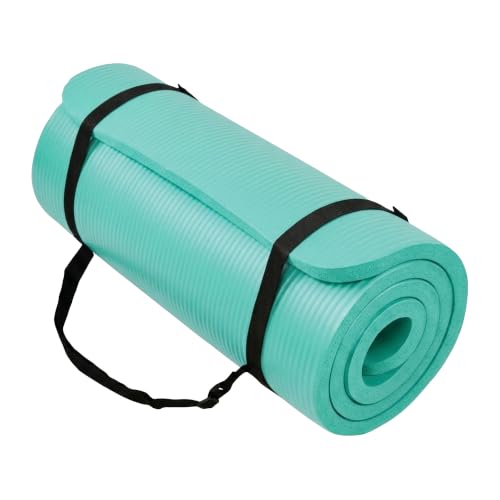
1 · Best overall
BalanceFrom Extra Thick Yoga Mat 1-InchAn inch of foam is the most impact absorption available in one rolled mat. You give up standing balance for it, and on a shared floor that is usually the right trade.
Maker lists thickness: 1 in (listing-stated)
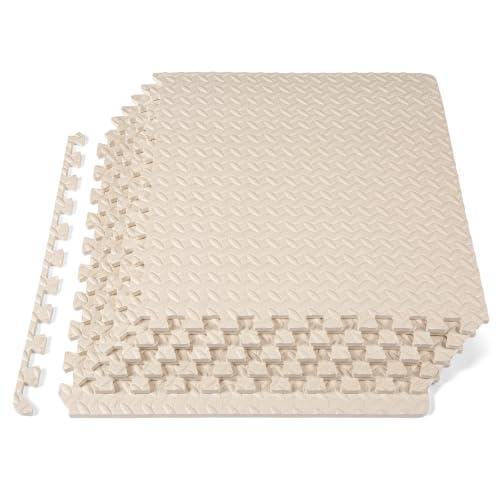
2 · Best layer under the mat
ProsourceFit Exercise Puzzle Mat 1/2-inchHalf-inch interlocking tiles that go under the mat you already own. The only setup here that gets you a soft floor and a surface you can balance on.
Maker lists tile size: 24 in x 24 in x 1/2 in (retailer-listed)
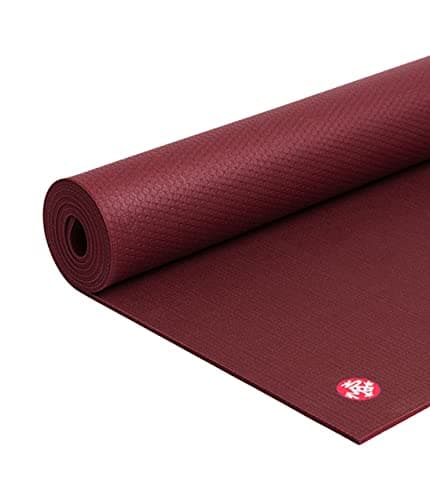
3 · Best mat to put on top
Manduka PRO 6mmDense, heavy and closed-cell: the practice surface that does not wobble when it is laid over a soft layer. On bare floorboards it is a mass layer, not a cushion.
Maker lists thickness: 6 mm
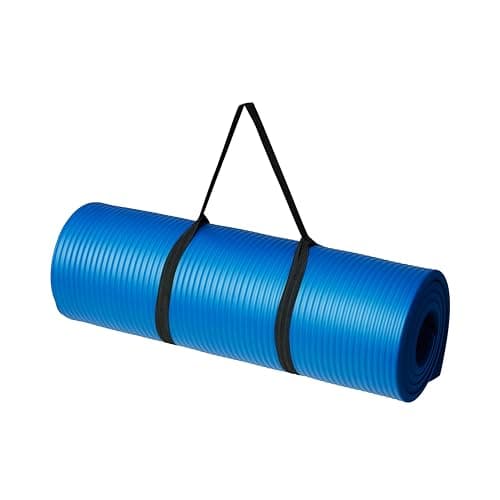
4 · Best first buy
Amazon Basics 1/2-Inch Extra Thick Exercise MatHalf an inch of foam for the least money here. Not as absorbing as the full inch, but enough to find out whether the complaints stop.
Maker lists thickness: 1/2 in (about 12.7 mm)
#ad · Prices come live from Amazon, last checked November 28, 2026. Figures here are the manufacturer's own. The ranking is editorial, made against the criteria on our How We Pick page, not from lab work. Photos come from Amazon. Tap a pick for the full write-up.
The short answer
Buy the thickest resilient layer you can tolerate standing on, and put your normal mat on top of it. On a shared floor, thickness is not a comfort feature — it is the only variable on a mat that changes how much of your practice arrives in somebody else’s ceiling. An inch of foam absorbs more impact than 6 mm of rubber, and nothing about grip, material or brand changes that.
If you want one purchase and no thinking: the inch-thick roll-up mat at the top of this list. If you already own a mat you like and do not want to replace it, the interlocking tiles are the better buy, because they let the mat you own keep doing the job it is good at while something underneath does the absorbing.
What the neighbor actually hears
There are two different noises and they travel differently, which is why the advice you get online contradicts itself.
- Impact noise is a foot, knee or block hitting the floor. The energy goes straight into the structure and comes out of the ceiling below as a thud. This is the one a mat can do something about, because a resilient layer absorbs some of the impact before it becomes sound in the floor assembly.
- Airborne noise is your music, your breathing, the instructor on your laptop. It travels through air gaps and thin partitions, and a mat has no effect on it whatsoever.
The building industry measures the first one with a rating called Impact Insulation Class, and the useful part of the standard for our purposes is the comparison it makes: a bare plywood or concrete floor sits at the bottom of the range, and the same floor with carpet and a resilient pad over it sits a long way up it. That gap is the whole reason this page exists. A thick mat is a small, mat-sized version of the carpet-and-pad layer, placed exactly where the impacts happen.
The same literature carries the warning you should hear before you spend anything: a resilient layer on top of a floor can fail to fix the problem on its own, because the result also depends on the joists, the insulation and the ceiling below. In an apartment you cannot change any of those three. So the mat is the lever you have, and it is a real lever, but it is not the whole machine.
What actually decides it
Three things, in this order. Note what is missing: grip, material, brand and price are all irrelevant to the noise question, however much they matter to the rest of your practice.
- Thickness. The single biggest variable, and the only one that scales. Going from a standard 4-6 mm mat to an inch of foam is four to six times the depth of material absorbing each landing. If you take one thing from this page, take this.
- Resilience, not just softness. A layer that compresses and springs back absorbs energy. A layer that bottoms out under your heel has stopped absorbing anything and is just passing the impact through. This is why a cheap thin foam mat is almost useless here and a dense inch of foam is not.
- Area. Impacts do not all land on the mat. A wide stance, a side-lying sequence, a dropped block — all of them land off the edge of a 24-inch mat and straight onto bare floor. Tiles cover more floor than a mat does, which is a real advantage and the reason they rank where they do.
Mass is worth a mention, because it comes up and it is half true. A heavy, dense mat like the Manduka PRO does damp a floor more than a light one, and it is also the mat that stays flat and stable when you put it over something soft. But mass without thickness is a small effect. Do not buy a heavy 6 mm mat and expect it to solve a complaint.
The two-layer setup
This is the part that most pages on the subject miss, and it is the recommendation worth reading twice. Thickness and stability pull in opposite directions: the thicker the foam, the more it absorbs, and the harder it is to stand on one leg on it. A single mat cannot be good at both. Two layers can.
| Setup | What it is good at | What it costs you |
|---|---|---|
| Standard 4-6 mm mat alone | Grip, balance, portability | Almost no impact absorption |
| One inch-thick foam mat | The most absorption in a single purchase | Standing balances genuinely wobble |
| Interlocking tiles alone | Absorption over a wide area | No grip; a sweaty hand slides on EVA |
| Tiles with your normal mat on top | Absorption underneath, grip and stability on top | Two purchases and floor space |
| Thick mat with a grippy towel on top | A workable compromise if storage is tight | Still soft underfoot; the towel shifts |
The fourth row is the right answer for most people who are serious about both halves of the problem. The tiles do the absorbing, the mat does the gripping, and the top surface stays as stable as the mat alone because a half-inch of dense EVA under a dense mat does not behave like an inch of soft foam under your foot. It is also the setup that lets you keep a mat you have already paid for and already like.
The one argument for the single thick mat over the two-layer setup is storage. A mat rolls and goes in a closet; a tiled floor comes apart into six tiles that have to live somewhere. In a studio apartment that is a genuine deciding factor, and it is why the roll-up mat is the pick at the top of this page rather than the tiles.
Why no mat publishes a number
You will not find an impact rating on any yoga mat, and that absence is worth understanding rather than working around. The ratings used in construction are measured on a whole floor assembly — the subfloor, the joists, the ceiling below — not on a product in isolation. A mat maker could not publish a meaningful figure even if it wanted to, because the number depends on the building it is used in.
What that means in practice is that every comparison on this page is made on the published thickness and the material, because those are the only figures that exist. We have not measured a decibel and nobody selling you a mat has either. Any page that quotes you a percentage reduction for a yoga mat invented it.
The practical substitute for a number is a test you can run in a day. Put the thickest layer you own down, do the loudest thing in your sequence ten times, and ask the person below. It is a crude measurement and it is the only one available to either of you.
What a mat cannot fix
Four things, and being straight about them will save you money:
- Jumping. A jump-back to plank or a jump-through is the loudest thing in a vinyasa practice by a wide margin, and no thickness of foam makes it quiet. Step back instead of jumping. This is a change to the practice, not a purchase, and it is more effective than anything on this page.
- Music and video. Airborne, so the mat is irrelevant. Headphones solve it completely.
- A dropped block. A cork block on a bare floor at 6 a.m. is the complaint you will actually get. Set props down rather than dropping them, and keep them on the mat rather than beside it.
- The time of day. The same thud at seven in the evening and at six in the morning are two different problems. If a schedule change is available to you, take it before you buy a mat.
It is also worth checking what you are standing on before you assume the mat is the variable. A practice over carpet starts with a resilient layer already in place and usually needs less help than you think; a practice on bare hardwood or laminate over joists is the hardest case, and it is the one this page is really written for. Concrete is in between: it transmits less through the floor than a timber assembly, but it carries sound sideways to your own walls instead.
In detail
Every pick, in full
1
Best overall
BalanceFrom Extra Thick Yoga Mat 1-Inch
As the manufacturer lists it · BalanceFrom
What it gets right
- An inch of resilient foam under every landing, knee and elbow
- Textured on both faces, so the side against the floor grips too
- Rolls and straps like a mat rather than needing floor space of its own
- Cheap enough to own alongside a proper practice mat
What it does not
- Standing balances are genuinely hard on this much foam
- An inch of foam creases where it is rolled and the creases stay
- Foam compresses under knees and elbows with regular use
- BalanceFrom publishes no density figure, so this foam cannot be compared with another maker's
Skip it if
your sequence is mostly standing work — the wobble will bother you more than the neighbors do.
#ad · Price as of November 28, 2026 · Affiliate disclosure for the link to BalanceFrom Extra Thick Yoga Mat 1-Inch
2
Best layer under the mat
ProsourceFit Exercise Puzzle Mat 1/2-inch
As the manufacturer lists it · ProsourceFit
What it gets right
- Lets you keep a thin, grippy practice mat and still get a soft floor under it
- Tiles lift and stack, so the room goes back to being a room
- Covers a wider area than a mat, which is what side-lying and rolling work wants
- Cheaper per square foot than almost any mat of the same thickness
What it does not
- Seams are visible and a tile corner can lift if you drag a mat across it
- EVA dents under furniture and under a knee that stays in one place
- New tiles have a foam smell that takes days of airing to go
- No published impact rating, so nothing about the noise reduction is quantified
Skip it if
you want one thing to buy and put away — this is a floor, not a mat.
#ad · Price as of November 28, 2026 · Affiliate disclosure for the link to ProsourceFit Exercise Puzzle Mat 1/2-inch
3
Best mat to put on top
Manduka PRO 6mm
As the manufacturer lists it · Manduka
What it gets right
- Dense enough that kneeling and forearm work stop hurting
- Closed cell, so sweat sits on top instead of soaking in
- Genuinely lasts — the lifetime guarantee is the maker's own
- An 85 in version exists if you are tall
What it does not
- Heavy. This is not a mat you carry far
- Slippery out of the box until the surface is broken in
- Closed-cell grip drops away once your hands are wet
Skip it if
you want grip on day one, practice hot, or need to carry the mat anywhere.
#ad · Price as of November 28, 2026 · Affiliate disclosure for the link to Manduka PRO 6mm
4
Best first buy
Amazon Basics 1/2-Inch Extra Thick Exercise Mat
As the manufacturer lists it
What it gets right
- One of the longest cheap mats at 74 in
- Foam is soft enough for knees straight away
- Easy to replace when it wears out
What it does not
- Slippery once your hands are damp
- Foam edges curl after a few months
- No grip texture worth the name
Skip it if
you sweat much at all — you will be sliding within ten minutes.
#ad · Price as of November 28, 2026 · Affiliate disclosure for the link to Amazon Basics 1/2-Inch Extra Thick Exercise Mat
What to look for
- Thickness first, and be honest about the number. 4 mm is a yoga mat. 10 mm is a compromise. An inch is a floor-exercise pad that you can also do yoga on. Pick the row of that table you can actually live with.
- Dense foam, not soft foam. If a mat feels like it bottoms out under a heel, it has stopped absorbing anything. The inch-thick mat here is listed as high-density foam for exactly that reason, and EVA tiles are a firmer foam than the surface of a cheap thin mat.
- Coverage wider than a mat, if the sequence is wide. Side-lying work, a wide warrior stance and anything on all fours puts a limb off the edge of a 24-inch mat. Tiles or a second mat laid alongside fixes it.
- A grippy top surface, one way or another. Thick foam is slippery when your hands are damp. Either the top layer is a real mat, or budget for a skidless towel to go over it.
- Storage before you buy. Six tiles stack to about the size of a small suitcase. If there is nowhere for that, buy the roll-up mat instead and accept the wobble.
- Ignore anything marketed as soundproof. No mat is. Thickness and density are the honest specifications; the word soundproof on a mat listing is a claim nobody has tested.
Two caveats about this category rather than any one product. The first is that the thick mats here are not really yoga mats, and the listings are honest enough about it — they are sold as exercise pads with yoga in the keyword list. If your practice is mostly standing and balancing, you will not enjoy an inch of foam, and the two-layer route is not a nicety for you but the only sensible option. See the thickness guide for what each millimeter band actually does to a standing pose.
The second is that cushion for a neighbor and cushion for your knees are the same purchase, so if you are buying for both reasons you are getting a bargain. If knees are the real driver and the noise is incidental, the mats for sore knees page ranks the same thickness question for a different reader, and a knee pad solves the knee half on its own for very little.
Finally: if you are setting up a practice corner from scratch rather than adding to one, the home space setup guide covers the floor, the wall space and the storage together, and what a mat should cost puts the tiers here in context. The quiet-floor problem is usually one decision inside a bigger one.
How we picked
Chosen on published criteria, and we say so
Most gear sites open by telling you how many hours they spent with the products. We have not used most of these, and we would rather say so than imply otherwise. Every pick here is chosen against criteria we publish — grip, cushioning, size options, what buyers report after a year of use, and whether the thing is still actually sold — and every manufacturer figure on the page is labeled as the maker's claim.
Nobody pays for a place on this page, no product was supplied free in exchange for coverage, and a specification the maker does not publish is never guessed at. See the full criteria and weighting.
FAQ
Questions people ask
Does a thick yoga mat really reduce noise for the apartment below?
What is the quietest yoga mat?
Should I put foam tiles under my yoga mat?
Will a yoga mat stop my neighbors hearing me jump?
Is a mat enough, or do I need a proper acoustic underlayment?
Does practicing on carpet already solve this?
Related
Keep reading
Update log
What changed
- First published.
Receipts
Sources
- 1.Soundproof Cow — What Is Impact Insulation Class? (the rating footfall and impact noise are measured by, and the typical ranges for bare and carpeted assemblies)
- 2.The Construction Specifier — Choosing the right acoustical underlayment (what IIC and delta-IIC measure, and why an underlayment alone does not always solve the problem)
- 3.US Rubber — What is acoustic underlayment (how a resilient layer absorbs impact energy before it becomes sound, and the thicknesses used in retrofits)
- 4.Walmart — ProsourceFit Puzzle Exercise Mat 1/2 in (24 x 24 in tiles, six-tile 24 sq ft coverage, EVA foam and the included border strips, as the retailer lists them)
- 5.BalanceFrom — exercise and yoga mats, including the interlocking EVA tile and extra-thick roll-up lines
- 6.Manduka — product information
- 7.OutdoorGearLab — The Best Yoga Mats
We have not used every product on this page, and we do not pretend otherwise. Thicknesses, materials, sizes and warranty terms are the manufacturer's published figures, shown as their claims. Anything about materials, skin or injury is linked to a source. Prices are set by Amazon and change constantly, so we never type one into the text — every figure comes from Amazon's own data, dated, and disappears rather than going stale. Read the full method.