Yoga Mats Best picks
The Best Yoga Mats for Kids
A kids mat is not a small adult mat with a print on it. It is a different size, and the size is the reason it works for a child and stops working around age nine.
We earn a commission when you buy through links on this page, at no extra cost to you. It never decides a ranking: the method is published. How we are funded
Quick picks
The short answer
1 · Best overall
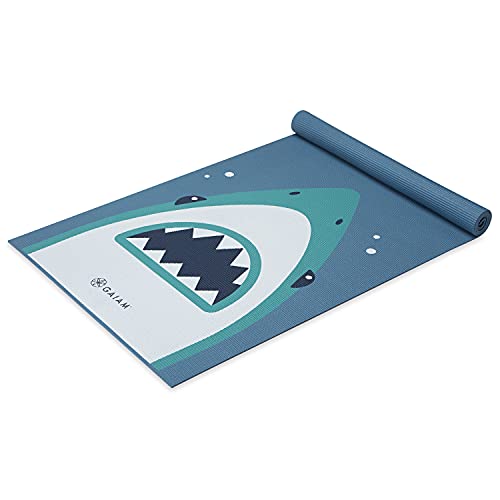
Gaiam Kids Yoga Mat 3mmThe standard 60 by 24 inch kids format at 3 mm, in prints a child will pick between. The default for roughly ages five to eight.
Maker lists size: 60 in x 24 in
2 · Best for practicing alone
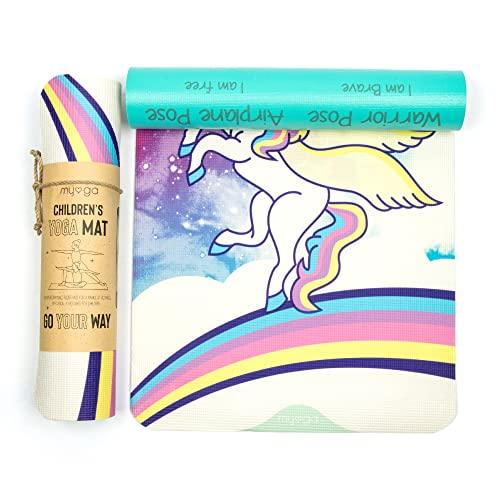
Myga Kids Yoga Mat with Printed PosesEight poses printed on the reverse face, which is the only feature here that changes what a child can do without an adult reading instructions out.
Maker lists size: About 59 in x 22 in (150 x 55 cm, retailer-listed)
3 · Best for a class
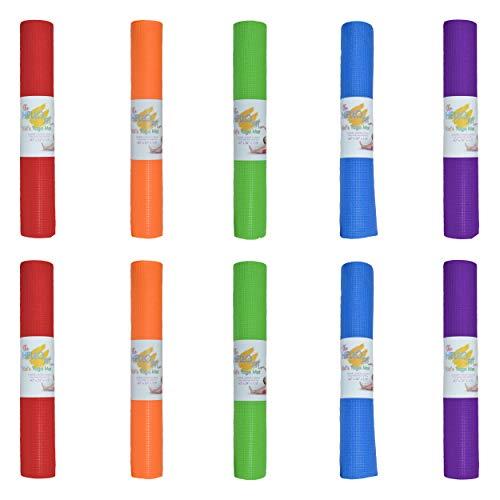
Hello Fit Bulk Kids Yoga Mats, 10 PackTen plain 4 mm mats in one box. The only sensible purchase for a classroom, a troop or a house with several children.
Maker lists size: 60 in x 24 in
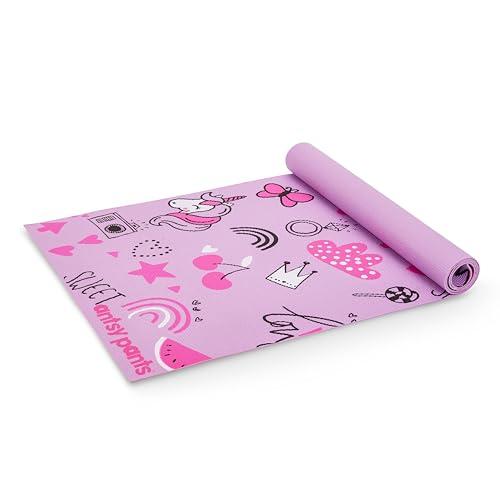
4 · Best first buy
Antsy Pants Kids Yoga MatThe same 60 by 24 inch, 3 mm format for the least money, with the phthalate claim spelled out on the listing.
Maker lists size: 60 in x 24 in
#ad · Prices come live from Amazon, last checked November 28, 2026. Figures here are the manufacturer's own. The ranking is editorial, made against the criteria on our How We Pick page, not from lab work. Photos come from Amazon. Tap a pick for the full write-up.
The short answer
Buy a 60 by 24 inch mat at 3 to 4 mm, let the child choose the print, and expect to replace it with an adult mat somewhere around age nine. That is the whole category. Almost every kids mat sold is the same size and the same thickness, the material is nearly always PVC, and the differences between them are the print, whether poses are printed on the back, and how many mats come in the box.
The size is not marketing. A standard adult mat is 68 to 72 inches long, and a six-year-old lying on one has a foot of mat past their head and another foot past their feet. A child who has to find where they are on a mat spends the session looking down. Sixty inches puts their hands and feet where the mat edges are, which is the same spatial cue an adult gets from an adult mat.
What actually decides it
Four things, in this order. Price is deliberately not on the list: the whole category sits in the same narrow bracket, and the gap between the cheapest and the dearest single mat here is smaller than the gap between two adult mats on any other page of this site.
- Length, against the child’s height. The mat should be a little longer than the child is tall. Sixty inches suits a child up to roughly four foot six; past that they are hanging off the end and an adult mat is the right purchase.
- Thickness, against the floor. 3 mm is fine on carpet and thin on tile. 4 mm is the better default if the mat will live on a hard floor, and it is the reason the multi-pack here is thicker than the single mats.
- What the listing says about the material. Most kids mats are PVC. The ones worth buying name the plasticizers they are free of rather than printing the word eco and leaving it there.
- Whether it washes. A child’s mat gets food on it. A wipe-clean surface is worth more than any other feature in year two of owning it, and printed surfaces wipe less happily than plain ones.
What does not matter: alignment lines, which a child will not use; carry straps, which get lost; and grip performance, because a child who is not sweating through a heated class does not have the grip problem that drives half the decisions on the adult beginner page.
The size question, by age
Heights vary enormously between children of the same age, so read this table as a height guide with ages attached rather than the other way around.
| Rough age | Typical mat | What to watch for |
|---|---|---|
| 3 to 5 | A 59 to 60 in kids mat, 3 mm | Plenty of spare mat. Narrower is better than wider at this age |
| 5 to 8 | 60 x 24 in kids mat, 3 to 4 mm | The sweet spot the whole category is designed for |
| 8 to 10 | 60 in still works, 4 mm preferred | Check feet and hands are not off the ends in a plank |
| 10 and up | A short adult mat, 68 in | A kids mat is now the thing limiting them |
| Any age, hard floor | Add a millimeter, or a second layer | Knees on tile are the usual complaint, not length |
The fourth row is the one parents get wrong, usually by buying a second kids mat rather than moving up. A ten-year-old on a 60-inch mat is in the same position an adult would be in on a 55-inch one, and it puts their hands on the floor in a downward dog. When that starts happening, the next mat is an adult mat — a plain 68-inch one from the entry-level list is the usual answer, and it will last them years.
What they are made of
Nearly every kids mat is PVC, including three of the four here, and it is worth being clear about what that does and does not mean. PVC is the same material as the plainest adult mats; it is cheap, it wipes clean, and it holds a print. The concern parents have about it is plasticizers, and the listings that deserve your money are the ones that name what they have left out rather than using a vague word.
- PVC with a published phthalate list. What the Gaiam and the Antsy Pants mats offer: specific named plasticizers the mat is free of. This is the ordinary standard in the category and it is a reasonable one.
- TPE. The plastic-free alternative, and a genuinely lighter material. Kids TPE mats exist but are less commonly stocked, and the ones we found do not publish their dimensions, which on a mat whose whole selling point is its size is a problem.
- Natural rubber or cork. Rare in kids sizes and much more expensive. Worth knowing about if latex is a concern in your house, because natural rubber contains it and PVC does not.
The practical point: do not pay a premium for a material claim on a mat the child will outgrow in three years. Pay attention to the phthalate statement, buy the size that fits, and spend the difference on a pair of blocks they will keep using long after the mat has gone.
One mat or ten
The multi-pack in this list is a different purchase from the other three and it is worth separating them clearly, because per-mat it looks like the obvious bargain and for one child it is not.
- One child: buy one printed mat. The print is the reason it gets unrolled. Ten plain mats in a cupboard is nine mats of storage and a child who is less interested than they would have been.
- Two or three children: buy two or three printed mats, in different prints. Whose mat is whose turns out to matter a great deal, and it is cheaper to solve with prints than with negotiation.
- A class, a troop or a childcare setting: buy the ten-pack. Plain surfaces wipe down faster between groups, 4 mm handles a hall floor better than 3 mm, and the single-color packs let you keep a set looking like a set.
One more use for the multi-pack that is not obvious: a family that already does yoga and wants mats for guests, grandparents and a child all at once. The mats are adult-adjacent in thickness and child-sized in length, which is an awkward spec for one buyer and a useful one for a household.
When to switch to an adult mat
There are three signals, and any one of them is enough:
- Hands or feet land off the mat in a plank or a downward dog. The clearest test, and the one to actually look at rather than guessing from a height chart.
- They are practicing beside you rather than being supervised. A child doing the same sequence as an adult wants the same mat as an adult, and the print has usually stopped mattering by then.
- The mat has creased or dented through. A 3 mm PVC mat used by an energetic nine-year-old on a hard floor is a consumable. When it goes, replace upward rather than sideways.
When that happens, the mat to buy is not a thicker kids mat. It is an ordinary adult mat in the thinner half of the range, because a child is light and does not need cushion so much as a surface that does not move. If the floor is hard, add a knee pad rather than buying a soft mat — the same advice this site gives adults, and for the same reason.
In detail
Every pick, in full
1
Best overall
Gaiam Kids Yoga Mat 3mm
As the manufacturer lists it · Gaiam
What it gets right
- A foot shorter than an adult mat, which is the whole point for a small child
- Prints children actually choose between, which is most of why a mat gets used
- Textured enough to hold a small hand in a downward dog
- Widely stocked in several designs, so a replacement is easy
What it does not
- 3 mm is thin for cartwheels and tumbling on a hard floor
- PVC rather than one of the plant-based or TPE materials
- 60 in stops fitting somewhere around age nine
- Care instructions differ between listings, which is not reassuring
Skip it if
your child is already taller than about four foot six — buy a short adult mat instead.
#ad · Price as of November 28, 2026 · Affiliate disclosure for the link to Gaiam Kids Yoga Mat 3mm
2
Best for practicing alone
Myga Kids Yoga Mat with Printed Poses
As the manufacturer lists it
What it gets right
- Printed poses give a child something to follow on their own
- Reversible, so the plain face is there when the poses get distracting
- Listed from age three, lower than most kids mats
- Narrower than 24 in, which suits a genuinely small child
What it does not
- Thickness varies by design and the listings do not agree
- Printed poses fade where feet and hands land most
- A UK brand, so some designs come and go from US stock
- No maker spec sheet to check the figures above against
Skip it if
the poses are the only reason you are tempted — a printed card on the wall costs nothing.
#ad · Price as of November 28, 2026 · Affiliate disclosure for the link to Myga Kids Yoga Mat with Printed Poses
3
Best for a class
Hello Fit Bulk Kids Yoga Mats, 10 Pack
As the manufacturer lists it
What it gets right
- A millimeter thicker than most kids mats, which a hard floor rewards
- Ten mats means no argument about whose mat is whose
- Plain surfaces wipe down faster than printed ones
- Sold in a single color if you want them to look like a set
What it does not
- Ten mats is a lot of storage for one child
- No prints, which is the thing that makes a young child unroll a mat
- Hello Fit does not publish a material breakdown
- Buying ten to get one cheap mat is false economy
Skip it if
you need one mat — the per-mat saving only counts if you need all ten.
#ad · Price as of November 28, 2026 · Affiliate disclosure for the link to Hello Fit Bulk Kids Yoga Mats, 10 Pack
4
Best first buy
Antsy Pants Kids Yoga Mat
As the manufacturer lists it
What it gets right
- The lowest cost of the single mats here
- The standard 60 by 24 kids format, so it fits beside an adult mat
- The listing names what it is free of rather than claiming to be eco
- Cheap enough to replace rather than scrub
What it does not
- 3 mm over a hard floor is thin for anything energetic
- Antsy Pants publishes no spec page at all
- Designs rotate, so a matching second mat may not exist
- Nothing here is better than the Gaiam except the price
Skip it if
the mat will live on tile or laminate — the extra millimeter of a thicker mat is worth more than the saving.
#ad · Price as of November 28, 2026 · Affiliate disclosure for the link to Antsy Pants Kids Yoga Mat
What to look for
- 60 by 24 inches, unless the child is very small or nearly grown. This is the format the category has settled on and it fits roughly ages five to eight. Shorter for a three-year-old, adult-sized past about four foot six.
- 4 mm over 3 mm if the floor is hard. One millimeter is a small difference on paper and a noticeable one under a knee on tile. It is the main reason to pick one of these over another.
- A named phthalate statement, not the word eco. Most of these mats are PVC. The ones worth buying tell you which plasticizers they have left out.
- A wipe-clean surface. It will need it. Check the care line on the listing you are buying, because the instructions genuinely differ between colorways of the same mat.
- Let the child pick the print. The least technical advice on this page and the one most likely to decide whether the mat gets used.
- Thicker still, if you live above someone. A child’s landings are the loudest thing in a household practice, and 3 mm does nothing to absorb them. The quiet-floor page covers the layer that goes under the mat.
- Printed poses if nobody in the house teaches. Poses on the reverse face give a child something to follow on their own. If you are practicing alongside them anyway, it is a feature you will not use.
One caveat about the information in this category rather than about any one mat: hardly any kids-mat brand publishes a specification page. Gaiam is the exception and even there the care instructions differ between listings for the same mat. Every figure on this page is labeled with where it came from, and where a brand publishes nothing we have said so on the card rather than quietly repeating a retailer as though it were the maker.
A note on what a child actually needs beyond the mat: very little. Two blocks and nothing else, and even the blocks are optional before about eight. A kids mat plus one block used as a prop covers everything a child’s sequence asks for, and the rest of the aisle is for adults. If you are building a first setup for the household rather than just the child, the beginner kit page is the order to buy in.
Finally, on where the mat lives. A child’s mat gets practiced on in a living room, which means it is also the household’s most-moved mat. A 3 mm PVC mat rolls small and weighs under two pounds, so storage is easy; what is not easy is keeping it flat if it is stored rolled the wrong way. How to store a mat applies to a kids mat exactly as it does to an adult one, and a creased kids mat is the usual reason a child stops wanting to use it.
How we picked
Chosen on published criteria, and we say so
Most gear sites open by telling you how many hours they spent with the products. We have not used most of these, and we would rather say so than imply otherwise. Every pick here is chosen against criteria we publish — grip, cushioning, size options, what buyers report after a year of use, and whether the thing is still actually sold — and every manufacturer figure on the page is labeled as the maker's claim.
Nobody pays for a place on this page, no product was supplied free in exchange for coverage, and a specification the maker does not publish is never guessed at. See the full criteria and weighting.
FAQ
Questions people ask
What size yoga mat does a child need?
How thick should a kids yoga mat be?
Are PVC kids yoga mats safe?
At what age does a child need a full-size yoga mat?
Is a kids yoga mat worth buying, or will an adult mat do?
Should I buy a multi-pack of kids yoga mats?
Related
Keep reading
Update log
What changed
- First published.
Receipts
Sources
- 1.Well.ca — Gaiam Kids 3mm Printed Yoga Mat (published 60 x 24 in size, 3 mm thickness, PVC construction and the phthalates it is free of)
- 2.Scary Mommy — the best kids yoga mats (why a kids mat is sized well below an adult mat)
- 3.Mom Loves Best — yoga for kids (the criteria reviewers weigh on a kids mat, plus the longer-length and classroom multi-pack options)
- 4.Gaiam — product information
- 5.NCCIH (US National Institutes of Health) — Yoga: What You Need To Know
- 6.ODPHP (US Dept of Health and Human Services) — Physical Activity Guidelines, Top 10 Things to Know (the adult aerobic and muscle-strengthening targets)
We have not used every product on this page, and we do not pretend otherwise. Thicknesses, materials, sizes and warranty terms are the manufacturer's published figures, shown as their claims. Anything about materials, skin or injury is linked to a source. Prices are set by Amazon and change constantly, so we never type one into the text — every figure comes from Amazon's own data, dated, and disappears rather than going stale. Read the full method.