Yoga Mats Guide
How to Choose a Yoga Mat
There are hundreds of mats and only four questions. Answer them in order and the shortlist writes itself, usually down to two or three options.
We earn a commission when you buy through links on this page, at no extra cost to you. It never decides a ranking: the method is published. How we are funded
The short answer
Choose on sweat first, knees second, length third, and weight last. Sweat decides the material, because only natural rubber, polyurethane and cork keep working when your palms are wet. Knees decide the thickness. Height decides the length. Weight only matters if the mat leaves the house.
If you want to skip the thinking entirely: a 6 mm PVC mat such as the Gaiam Premium is the right first mat for most people in most rooms, and you will learn more from three months on it than from three weeks of research. The beginner roundup is the shortlist version of this page.
1. How much do you sweat?
This is the first question because it is the only one where getting it wrong makes the mat unusable rather than merely imperfect. A mat that goes slick under wet palms will send your hands sliding forward in downward dog, and no amount of technique fixes it.
Three honest answers, and what each one points at:
- Barely, and the room is cool. Any mat material works. Buy on thickness and price. PVC and TPE are both fine.
- Noticeably, in a normal room. You want natural rubber or cork. Both grip damp skin; smooth PVC does not. Cork versus rubber settles which.
- Heavily, or the class is heated. You want a polyurethane top layer, or any mat plus a skidless towel. This is the one case where the cheap accessory genuinely competes with the expensive mat — see the hot yoga roundup.
A warning about a very common disappointment: dense premium PVC mats are slippery when new, for one to three weeks, and this surprises people who just spent real money. That is break-in, not a fault, but it is worth knowing before rather than after.
2. How do your knees feel?
Thickness is a trade, not an upgrade. More padding is kinder to knees, shins and elbows, and it makes standing balances harder because the surface moves under your foot. The band you want depends on which of those two you notice more.
| Thickness | Who it is for | The cost |
|---|---|---|
| 2-3 mm | Travel, carpet, stability-first practices | Uncomfortable kneeling on a hard floor |
| 5-6 mm | Almost everyone. The default band | Very little; this is the compromise |
| 8-13 mm | Sore knees, mostly floor work | Standing balance gets genuinely harder |
Two things that matter more than the number itself. First, density beats thickness: a dense 6 mm mat is more comfortable to kneel on than a soft 10 mm one, because the soft one keeps compressing until your kneecap reaches the floor anyway. Second, a knee pad solves kneeling without costing you stability, which is frequently the smarter purchase. Both arguments are expanded in the thickness guide.
Your floor is part of this question. Carpet does some of the cushioning for you, so a thinner mat is fine and a thick one gets unstable — carpet changes the answer. Wood and tile do none of it, which is why hard floors have their own picks.
3. How tall are you?
The standard mat is 68 inches long and 24 inches wide, and it was not chosen for you. If you are much above average height, your heels hang off the end in savasana and your hands run off the top in a long downward dog. The fix is a 71, 72, 80 or 85 inch mat, and the number of mats offering those lengths is small.
Width is the quieter problem. 24 inches is tight for broad shoulders and for wide-stance standing poses, and 26 to 28 inch mats exist for exactly that. The cost is a fatter roll to store and carry. The size guide lists which models come long and wide, because this is the one specification you cannot work around with technique.
4. Do you carry it?
Answer this last, because it only overrides the others if the answer is yes. A mat that stays in one room can be as heavy as you like, and weight is actively useful there: heavy mats lie flat immediately and do not creep on smooth floors.
A mat that goes to a studio twice a week is a different object. Dense 6 mm mats are heavy, and the gap between a heavy mat and a light one is the gap between going and not going. That is the entire reasoning behind the PRO versus PROlite decision, and for a mat that folds into a suitcase you want a dedicated travel mat rather than a compromise on your main one.
The picks
One mat per answer
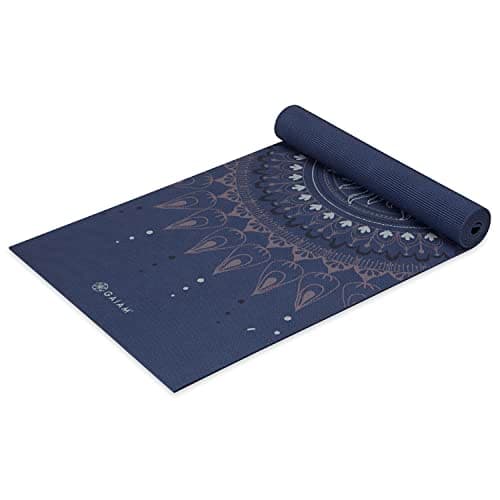
A first mat
Gaiam Premium 6mm Yoga Mat
The default first mat. Enough cushion for a beginner, a printed design you will not hate, and a price that makes quitting after a month painless.
$21.90Amazon#ad · Price as of November 3, 2026 · Affiliate disclosure for the link to Gaiam Premium 6mm Yoga Mat
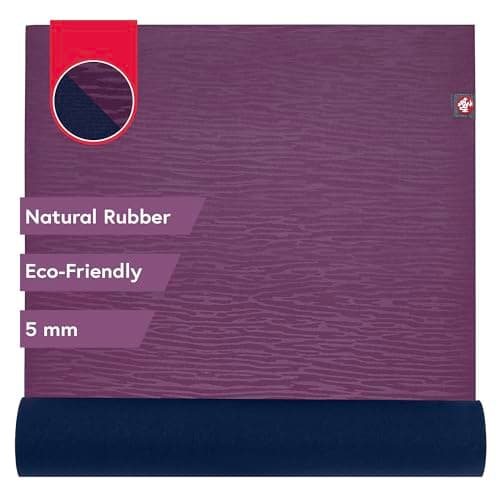
Grip without a break-in
Manduka eKO 5mm
Natural rubber with real grip from the first session and no break-in. The rubber smell is strong for the first couple of weeks and then fades.
$87.54Amazon#ad · Price as of November 3, 2026 · Affiliate disclosure for the link to Manduka eKO 5mm
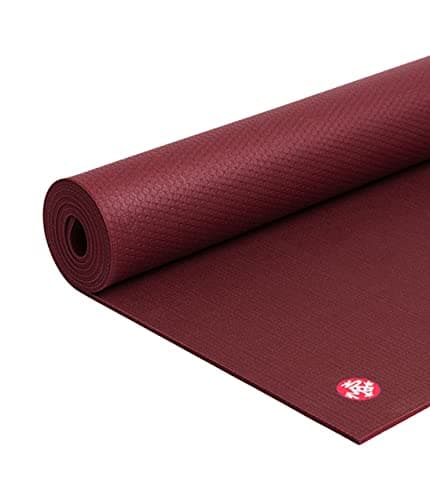
Sensitive knees and wrists
Manduka PRO 6mm
The most cushioned mat most people will ever need, and the one that outlives every other mat in this list. It is also heavy, and it is slippery until you break it in.
$144.00Amazon#ad · Price as of November 3, 2026 · Affiliate disclosure for the link to Manduka PRO 6mm
What you can safely ignore
- Alignment lines. Genuinely useful for some beginners and clutter for others. Never worth choosing a worse mat to get.
- Antimicrobial claims. A mat you wipe down is clean. A mat you never wipe is not, whatever the label says.
- Reversible designs. One side is almost always grippier. You will use that side.
- Eco credentials as a tie-breaker, not a starting point. Natural rubber, cork and TPE are all defensible choices; the material still has to grip in your practice first. The full material rundown is in mat materials explained.
- The number on the box, in isolation. Two mats labeled 6 mm can feel nothing alike, and the variable is density.
One last piece of sequencing advice. If this is your first mat and you are honestly unsure whether yoga becomes a habit, buy inexpensively now and properly later — the entry-level picks exist for that, and three months of practice will tell you more about what you want than any specification table.
Two decisions this guide deliberately leaves out: how much to spend, which is laid out tier by tier in what a mat should cost, and whether you want printed guide lines on the surface, which is covered in the alignment mats roundup.
How we picked
Chosen on published criteria, and we say so
Most gear sites open by telling you how many hours they spent with the products. We have not used most of these, and we would rather say so than imply otherwise. Every pick here is chosen against criteria we publish — grip, cushioning, size options, what buyers report after a year of use, and whether the thing is still actually sold — and every manufacturer figure on the page is labeled as the maker's claim.
Nobody pays for a place on this page, no product was supplied free in exchange for coverage, and a specification the maker does not publish is never guessed at. See the full criteria and weighting.
FAQ
Questions people ask
What is the most important thing when choosing a yoga mat?
What thickness yoga mat should a beginner buy?
Which yoga mat material is best?
Does a more expensive yoga mat actually practice better?
What size yoga mat do I need?
Related
Keep reading
Update log
What changed
- First published.
Receipts
Sources
- 1.OutdoorGearLab — The Best Yoga Mats
- 2.Yoga Journal — Best Yoga Mats
- 3.Healthline — The Best Workout Mats
- 4.Reviewed — The Best Yoga Mats
- 5.Treeline Review — Best Yoga Mats
We have not used every product on this page, and we do not pretend otherwise. Thicknesses, materials, sizes and warranty terms are the manufacturer's published figures, shown as their claims. Anything about materials, skin or injury is linked to a source. Prices are set by Amazon and change constantly, so we never type one into the text — every figure comes from Amazon's own data, dated, and disappears rather than going stale. Read the full method.